

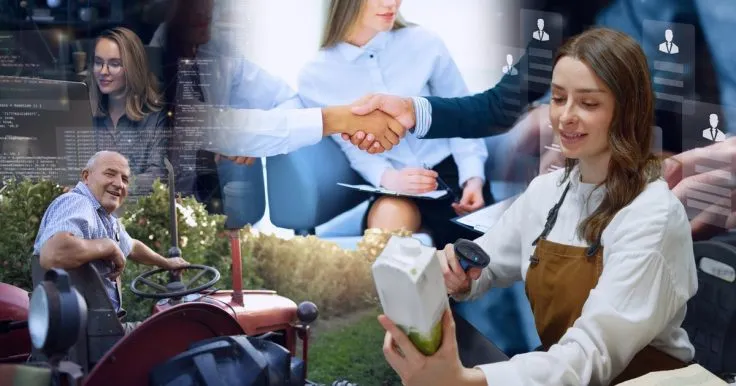
The Ukrainian labor market has undergone significant changes due to the impact of military events. Businesses across various sectors are moving away from classical motivation models, focusing on the safety, psychological support, and stability of their employees and their families. Changes in personnel structure, mobilization, and staff shortages have forced companies to seek new approaches to attracting, retaining, and developing employees.
This is reported by Finway
Agricultural Sector: Adapting to Staff Shortages and Supporting Employees
Agricultural companies have felt the impact of the war acutely due to a lack of personnel, working in stressful conditions, and constant danger. Therefore, enterprises are changing operational processes and reviewing bonus and social protection systems. The formulas for calculating bonuses have been adapted to reduce the burden of wartime and provide opportunities for larger additional payments compared to pre-war times.
In the agricultural sector, mental health programs have significantly expanded, legal consultations have been introduced, coaching for managers, thematic webinars, and support groups for military families. The Wellbeing program covers financial, mental, organizational well-being, and physical health, all components of which are adapted to the realities of wartime.
“Our mental health program has significantly expanded: in addition to free consultations with psychologists, legal consultations, coaching for managers, regular webinars on mental health, and a support group for the families of servicemen ‘Berehyni’ have been added. Our Wellbeing program includes components such as financial, mental, and organizational well-being, as well as physical health. All of them have undergone certain changes during the war that improve the lives of employees,” says HR Director of ‘Agroprosperis’ Lyudmyla Horova.
The social package has also undergone changes: increased payments for childbirth, assistance policies for those affected by the war, additional payments for employees in frontline regions, housing rent compensation, and summer vacation programs for children.
To stabilize employees’ emotional states, sports initiatives have been expanded, including organized football tournaments that have become popular among the male staff. The staff shortage is being addressed through internal training, attracting interns to key positions, and implementing a model of internal personnel outsourcing among group companies.
Manufacturing, Distribution, and Banking: New Approaches to Motivation and Employee Development
In manufacturing companies, such as Bayadera Group, the war has highlighted the role of HR as a support system and adaptation to changes. Despite the mobilization of about 10% of the staff, businesses are constantly seeking new specialists, reviewing approaches to recruitment, supporting the families of mobilized employees, and expanding youth development programs through internships and training.
Reintegration programs for veterans involve an individual approach, the opportunity to change professions within the company, training, and support from management. Internal mobility has become important: employees can move to safer regions without losing their jobs thanks to the company’s branches in different cities.
Due to the growing shortage of skilled workers, businesses are considering attracting foreign specialists, especially in manufacturing specialties, while maintaining corporate culture and team spirit.
The banking sector emphasizes safety, stability, and psychological support for employees. Financial assistance, additional leave, and compensation for psychological services have become standard in large banks. At the same time, money remains an important factor; however, long-term employee retention is ensured through corporate culture, flexibility, and support.
Systemic banks are implementing reintegration programs for veterans, adapting workplaces, training managers in inclusive communication, and supporting families. There is a trend to retain 100% of jobs for employees serving in the Defense Forces and to develop special programs to attract veterans.
It is particularly challenging for banks to retain IT specialists, cybersecurity experts, analysts, and risk managers. Young people seeking flexibility and development are attracted through internships, master classes, and training, forming a new style of communication without hierarchical barriers.
A modern employer in the market is a company that honestly fulfills its obligations, cares about safety, supports the team, and demonstrates an active civic position, which is becoming increasingly important for employees during wartime.