

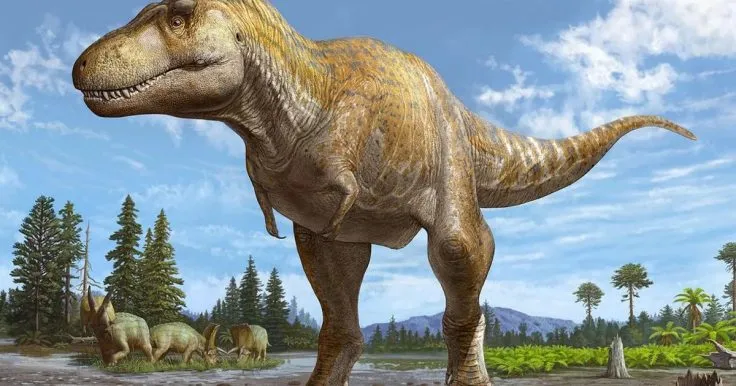
For many years, scientists have tried to answer the question of why the fearsome Tyrannosaurus, which reached a length of nearly 14 meters, had surprisingly short front limbs. Now, researchers from University College London have presented a new explanation for this evolutionary mystery.
This is reported by Finway
Evolutionary Advantage of Short Limbs
The height of an adult Tyrannosaurus reached 13.7 meters, but the length of its arms was only 90 centimeters. For comparison, this would be like a person 180 cm tall having arms measuring 12.5 cm. Such a proportion has long puzzled paleontologists.
Scientists in London studied the development of limbs in various species of large theropods and concluded that the reduction of front limbs was related to the strengthening of the head and jaws — these became the primary tools for attack and hunting.
“It is well known that the Tyrannosaurus had tiny arms, but other giant theropod dinosaurs also developed relatively small front limbs. The Carnotaurus had incredibly tiny arms, smaller than those of the Tyrannosaurus,” says Charlie Roger Scherer, the lead author of the study.
The Head as the Main Weapon
According to the research, as Tyrannosaurs transitioned to hunting much larger prey, the role of the front limbs diminished. Gradually, they lost their significance as an attack tool, while the massive head and powerful jaws took on the main load.
Researchers claim that this adaptation helped Tyrannosaurs more effectively deal with large prey, such as 30-meter sauropods, which would be difficult to hold with claws. As a result, evolution favored the reduction of the arms, as they became unnecessary for survival.
Thus, the short limbs of the Tyrannosaurus are not a random anomaly, but an evolutionary strategy that allowed this species to become one of the most successful predators of its time.