

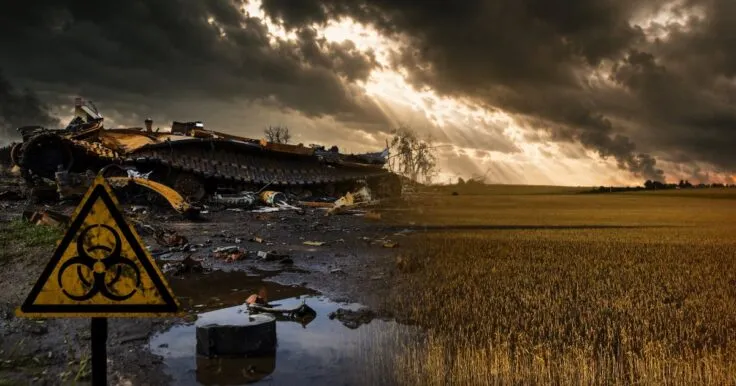
A significant part of Ukraine’s territory is already suffering from the consequences of hostilities with Russia: massive mining, soil contamination, and the destruction of natural ecosystems create enormous ecological risks. As a result of the war, certain Ukrainian lands may remain dangerous for human life, agriculture, and use for many years, if not decades.
This is reported by Finway
Growing scale of ecological damage
The ecological problems related to the war are becoming particularly relevant for Ukraine against the backdrop of annual global UN initiatives. According to information from the Ministry of Environmental Protection and Natural Resources of Ukraine, by 2025, over 30% of the country’s territory will have varying degrees of pollution or damage due to the war. More than 2.5 million hectares of land are potentially mined. Thousands of cases of soil contamination with petroleum products, heavy metals, and remnants of explosives are being recorded.
UN experts emphasize that the consequences of the war for ecology are cumulative and long-lasting: pollution does not disappear with the cessation of hostilities but continues to spread into soils, waters, and food chains.
“War leaves behind not only destroyed cities but also territories that may be dangerous for life for decades. We are already seeing how large areas of land are turning into ecological risk zones, and restoring these territories will require systematic international work,” said Yuliya Marhel, leader of the all-Ukrainian youth movement Let’s Do It Ukraine.
“Dead zones” and regions of increased risk
According to ecologist Vladyslava Bandura, the term “conditionally dead territories” is used to describe areas where living is dangerous due to the threat of mines, severe chemical contamination, or complete destruction of ecosystems. Such territories may remain unfit for use for 5-10 years to several decades — it all depends on the level of contamination and the pace of demining.
According to estimates from the UN Environment Programme (UNEP), the restoration of ecosystems after military conflicts can take from 20 to 50 years, and sometimes even longer. The southern and eastern regions of Ukraine, which have suffered the most from hostilities, mining, fires, and man-made disasters, remain the most vulnerable.
Particular concern is raised by the Kherson region and the area of the former Kakhovka Reservoir. The destruction of the Kakhovka Hydroelectric Power Plant dam has led to a massive change in the ecosystem of the Lower Dnipro: significant areas have been flooded or drained, and bottom sediments containing over 90 thousand tons of heavy metals have become a potential source of long-term pollution of the Dnipro and the Black Sea.
The Donetsk and Luhansk regions have been suffering from the accumulation of ecological problems for over ten years. In addition to the consequences of the war, these regions face risks of flooding mines, destruction of industrial enterprises, and contamination of groundwater. Experts note that the combination of military and industrial pollution makes the Donbas one of the most challenging regions for recovery in Ukraine.
In the Kharkiv region, scientists are recording large-scale destruction of the soil cover, numerous craters from explosions, fires, and the loss of part of the natural fertility of the land. Protected areas in the south of the country — Kinburn Spit, Oleshky Sands, Lower Dnipro, Black Sea Biosphere Reserve, and Askania-Nova — have also been affected. About 20% of all protected areas in Ukraine have been impacted by the war, some of which remain occupied or inaccessible for detailed monitoring.
Recovery and challenges for the future
The biggest ecological challenge after the cessation of hostilities will be the restoration of millions of hectares of land, cleaning water resources, and restoring natural landscapes. An important condition for this is the elimination of mine danger and toxic pollution, as well as conducting ecological audits and land reclamation.
Experts emphasize that even after the end of the war, the process of ecological rehabilitation will take decades. Only after demining will it be possible to fully restore natural ecosystems and return lands to economic circulation.
At the same time, nature has a powerful potential for self-restoration, but only with the active participation of the state, the international community, and systematic work to eliminate the consequences of the war.
Rising temperatures, more frequent droughts, water resource shortages, and ecosystem degradation amplify the need for ecological rehabilitation in Ukraine as an element of national security. As Vladyslava Bandura notes, “World Environment Day in 2026 for Ukraine is a reminder that ecology is part of national security. Territories destroyed by war require not only demining but also long-term ecological rehabilitation, which can take decades.”