

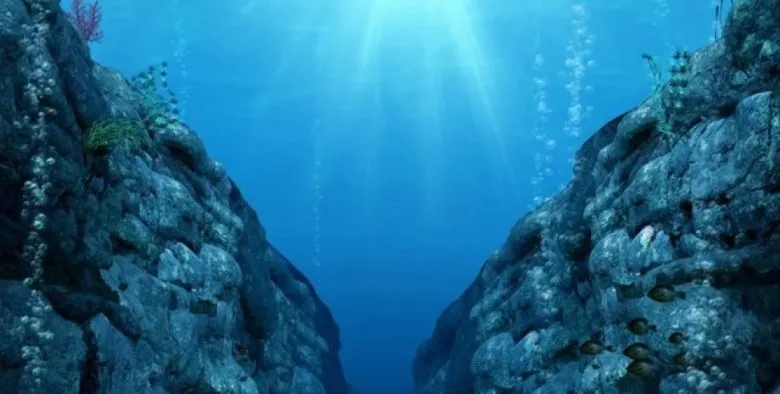
An international group of scientists has revealed for the first time the reasons behind the emergence of a large system of trenches in the center of the North Atlantic, known as the Royal Trench. This unique geological structure surpasses the Grand Canyon in size, and its origin is linked to a complex of tectonic processes and increased temperatures in the Earth’s mantle.
This is reported by Finway
The Geological Uniqueness of the Royal Trench
The Royal Trench is located approximately a thousand kilometers west of Portugal and stretches nearly 500 kilometers. It consists of several parallel troughs, and at its eastern edge lies one of the deepest points in the Atlantic — Peak-Dep. Despite the absence of ocean currents that could create such valleys, landscapes have formed on the ocean floor that exceed even their terrestrial counterparts in scale.
Tectonic Processes and the Role of the Mantle Plume
Research led by the GEOMAR Helmholtz Centre for Ocean Research (Germany) showed that between 37 and 24 million years ago, this region was a temporary boundary between the European and African lithospheric plates. During this period, the Earth’s crust not only shifted but also ruptured from the northeast to the southwest, leading to the formation of long trenches.
Marine geologist Antje Dürkevelden emphasized that the unusually thickened and heated oceanic crust was crucial. According to the researchers, these conditions arose due to an active mantle plume — the precursor to the modern Azores plume.
“The uplift of hot material from the depths of the Earth may have weakened the crust, making it more susceptible to tectonic rupture precisely in this location.”
The southward movement of the plate boundary towards the modern Azores islands halted the formation of troughs in the Royal Trench, confirming a direct link between processes in the mantle and deformations in the upper layers of the Earth’s crust.
The findings of the study allow for a better understanding of contemporary tectonic processes in the region. In particular, a new system of troughs is currently forming in the Azores area — the Terceira Rift, which arises above similarly thickened oceanic crust.
Materials for the study were collected during the M168 expedition aboard the research vessel METEOR in 2020. Using high-resolution sonar, scientists created a detailed map of the seafloor and collected samples of volcanic rocks. Their age was determined in laboratories, including at the University of Madison (USA).