


In the northern part of Spain, in Lower Cretaceous deposits, paleontologists have discovered a new species of dinosaur that could significantly change our understanding of the evolution of herbivorous reptiles in Europe. The new species has been named Foskeia pelendonum. Despite its small size — a body length of less than 50 centimeters — Foskeia was distinguished by a complex skull structure, which contradicts previous notions of anatomical simplification in miniature dinosaurs.
This is reported by Finway
Features of Foskeia pelendonum: Size and Anatomy
The remains of this dinosaur were found in the Vegagete formation. Scientists led by paleontologist Paul-Emile Dieudonné studied the bones of at least five individuals. The most striking aspect is the combination of an extremely small body with a developed, “adult” skull architecture. This confirms that a reduction in size does not necessarily accompany the loss of complex anatomical features.
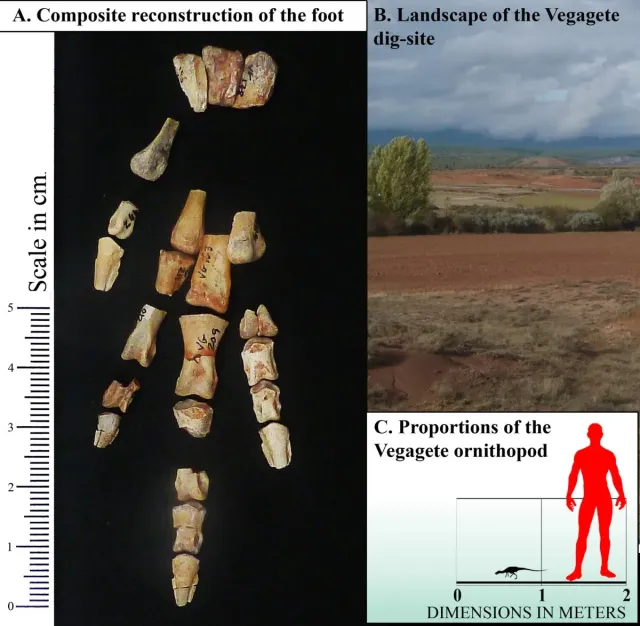
The genus name Foskeia is derived from ancient Greek words indicating lightness and feeding habits, while the species name pelendonum is associated with the Celtiberian tribe that once inhabited the area. This combination reflects both the biological and historical significance of the discovery.
Evolutionary Role and New Questions for Science
The anatomical analysis conducted has classified Foskeia pelendonum among the early representatives of the European line Rhabdodontomorpha — a group of herbivorous dinosaurs whose evolutionary history still has significant gaps. Notably, thanks to this find, scientists were able to fill in about 70 million years of evolutionary history for this branch.
The results of the histological analysis were equally important. The microstructure of the bones proved that the largest specimens were adults, not juveniles. According to Dr. Cohen Stein, the growth rates of Foskeia resembled the metabolism of small birds or mammals, which is atypical for many dinosaurs.
Phylogenetic analyses have updated the hypothesis regarding the existence of a broader group, Phytodinosauria, which could encompass all herbivorous dinosaurs in a common clade. However, as researchers emphasize, additional finds are needed to confirm this idea.
Foskeia pelendonum clearly demonstrates that the evolution of dinosaurs did not solely proceed through gigantism. Alongside giant species, there existed surprisingly small yet anatomically complex forms capable of occupying their own ecological niches. Such discoveries compel scientists to reassess established notions about the first herbivorous dinosaurs in Europe.