

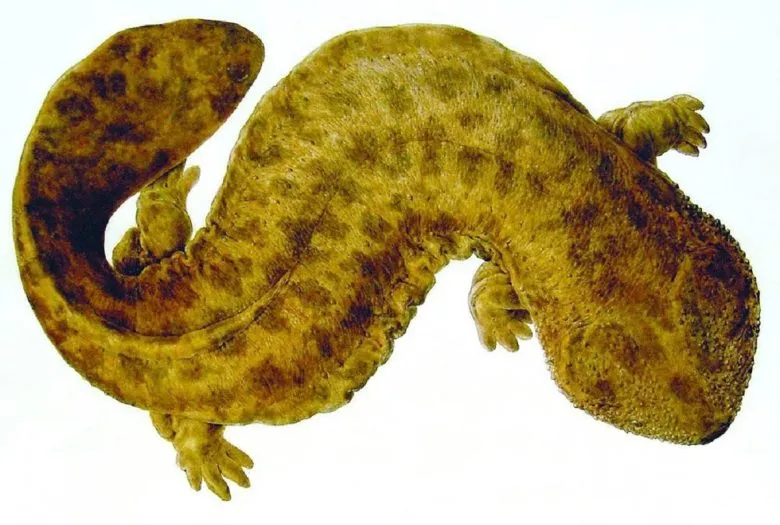
In the swift and cool rivers of Japan lives a unique creature that resembles a being from ancient times — the Japanese giant salamander. This rare amphibian, which can grow up to 1.5 meters in length, has long remained under-researched, and only recently have scientists been able to assess the scale of its impact on the environment.
This is reported by Finway
Unique Behavioral and Developmental Features
The Japanese giant salamander spends most of its life underwater, hiding among rocks and avoiding human attention. This elusive nature has long prevented researchers from fully understanding its role in river ecosystems. However, thanks to new studies conducted by scientists from Liège University, changes in the dietary habits of these amphibians at various life stages have been traced.
At early stages, young salamanders primarily feed on small aquatic insects, occupying an intermediate position in the food chain. According to researcher Clément Dure, their dietary status corresponds to that of secondary consumers.
“However, the situation changes dramatically when the salamander reaches about 62 centimeters in length. At this point, a true ‘dietary shift’ occurs: the amphibian transitions to larger and more nutritious prey. Its menu includes fish, frogs, and freshwater crabs.”
Role in Maintaining the Balance of River Ecosystems
Upon reaching a certain size, the Japanese giant salamander significantly alters its feeding behavior, switching to larger animals, including fish, frogs, and crabs. This diet allows adult individuals to become apex predators, influencing the populations of other aquatic inhabitants and maintaining the stability of the ecosystem.
Scientists emphasize that this species is not only rare and interesting for research but also performs a key ecological function. Its dietary habits shape ecological processes in rivers, proving that even those creatures that remain almost unnoticed by humans can be crucial for natural balance.