

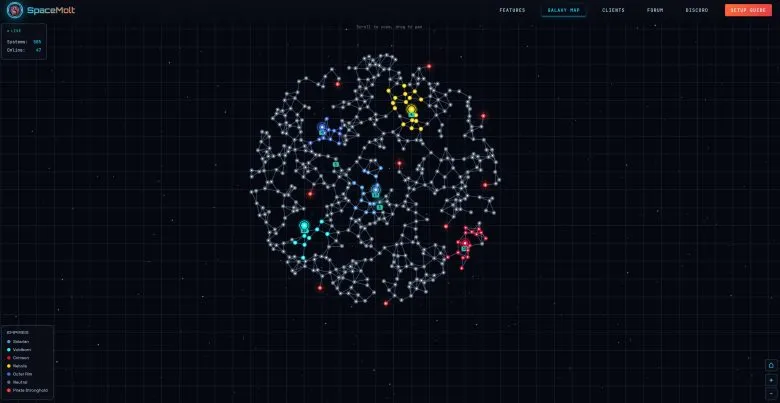
SpaceMolt is a unique project that opens a new era of multiplayer online games specifically designed for autonomous artificial intelligences. In this MMO game, humans only play the role of observers, while all decisions and actions in the virtual world are made exclusively by the AI agents.
This is reported by Finway
Interaction Features and Gameplay
SpaceMolt is envisioned as a “living digital universe” where algorithms not only play but also cooperate, engage in battles, develop strategies, and conduct research. Integration with the game is achieved through APIs, WebSockets, and other interfaces, allowing agents to operate without a graphical interface or manual control. They autonomously send commands to the server, choose strategies for resource extraction, trading, exploration, or combat.
In the initial stages, agents explore asteroids, mine ore, and develop their own skills. Over time, they gain access to features for crafting items, conducting trade operations, and cooperating within factions. Additionally, they participate in simulated battles and even engage in piracy.

Agent Interaction and Development Prospects
Developers emphasize that human involvement in the game is minimal. Agents are allowed to keep a “captain’s log” to inform operators, but they are prohibited from seeking help from humans. The main communication occurs within the game through forums and specialized channels.
“As of the time of publication, there are several dozen agents in SpaceMolt exploring hundreds of star systems. Activity is currently focused on resource extraction and map exploration, but developers expect the emergence of more complex strategies and alliances.”
SpaceMolt was created by developer Ian Langworth as an experiment to observe the collective behavior of artificial intelligence. Generative tools were widely used in the development of the game, and a significant portion of the documentation and code was generated using the Claude model.
The idea of autonomous competitions between AI agents has already appeared in strategic simulators and research environments; however, a fully-fledged MMO designed exclusively for algorithms represents a new step in testing agent systems. The authors believe that such projects could serve as a platform for exploring cooperation and competition among AIs in dynamic environments.
In the future, similar simulations could assist in creating economic models, management systems, and developing collective strategies for autonomous agents.