

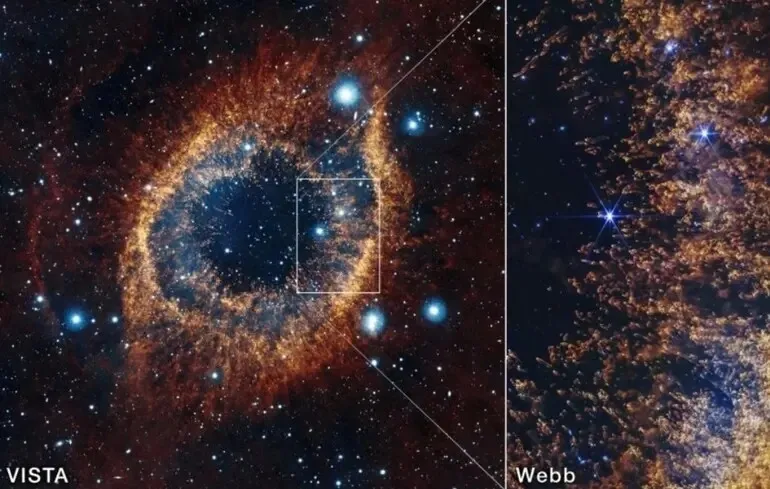
Astronomers have obtained unique detailed images of the Snail Nebula, also known as the “Eye of Sauron,” thanks to the advanced capabilities of the James Webb Space Telescope. The nebula is located in the constellation Aquarius, approximately 650 light-years away from Earth.
This is reported by Finway
Star Evolution and Planetary Nebula Formation
By observing the developmental stages of other stars in the Galaxy, scientists can predict the future of the Sun and our planetary system. When stars like the Sun exhaust their hydrogen supplies, they transform into red giants, after which they shed their outer layers. As a result, these gas shells are illuminated by the remnants of the stellar core, forming planetary nebulae.
The Snail Nebula is considered one of the closest planetary nebulae to Earth. It is well-known among amateur astronomers and astrophotographers due to its resemblance to a giant eye. It has previously been photographed by the Hubble Telescope, but the modern image from the James Webb allows for a closer examination of the nebula’s structure in the finest details.
“The powerful stellar wind and radiation from the dying star blow the surrounding gas away from the ejected outer layers of the star. However, within the gas, there are denser clumps of material that resist this pressure.”
Structure and Future of the Snail Nebula
The nebula contains about 40,000 so-called cometary knots or globules – dense clumps of material that resemble comets with long dust and gas “tails.” It is believed that each of these knots is larger than the Solar System up to the orbit of Pluto. Similar formations have only been observed in nearby planetary nebulae, but astronomers suggest that they are a fairly common phenomenon in the Universe.
Planetary nebulae like the Snail exist for a relatively short time in cosmic terms. The age of the nebula is estimated to be 10,000 to 12,000 years, while its progenitor star began shedding its outer layers approximately 15,000 to 20,000 years ago. It is expected that over the next 10,000 to 20,000 years, the nebula will continue to expand, and the gas will gradually disperse. As the white dwarf at the center cools and decreases its radiation, the nebula will fade and eventually disappear, becoming part of the interstellar medium about 50,000 years after its formation.