

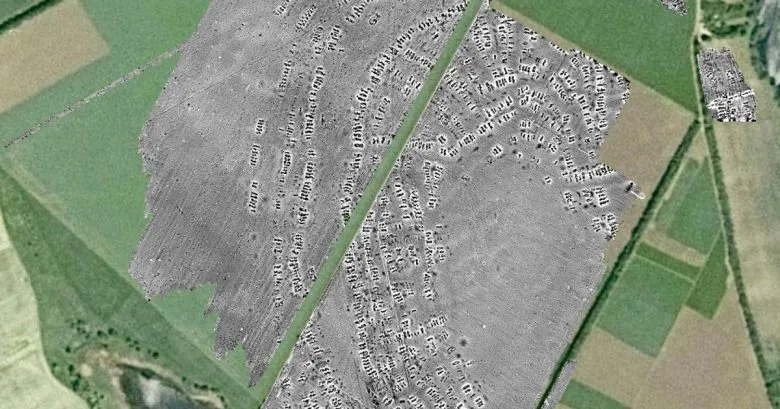
An archaeological site in Ukraine has attracted significant international scientific attention. Researchers hypothesize that the first settlements with clear urban planning may have emerged in Eastern Europe, predating the earliest cities of Mesopotamia.
This is reported by Finway
Uniqueness of the Tripolye Mega-Site
Over half a century ago, a mega-site of the Tripolye Culture was discovered, which is now considered one of the oldest structures exhibiting signs of urban planning. Archaeologists emphasize that the Cucuteni–Tripolye culture may have appeared before the Mesopotamian cities, thereby challenging established views on where the urban “revolution” began.
Mesopotamia is traditionally viewed as the cradle of civilization, as it was here, in the Fertile Crescent, that the first settled agricultural communities emerged. Ancient Uruk, which became a city-state around 3500 BC, is still regarded as a classic example of early urban planning. However, the discovery of the Tripolye site near Kyiv alters this perspective.
Archaeological Discoveries and Further Research
Near Kyiv, archaeologists excavated a settlement covering approximately 320 hectares, designed in the form of concentric circles—a true prototype of an urban plan. According to researchers, at its peak, this settlement could have housed up to 10,000 inhabitants.
The first traces of the Cucuteni culture were found in Romania as early as 1884. The Tripolye site near Kyiv was discovered in the 1960s when Soviet topographer Konstantin Shishkin noticed strange concentric shadows in aerial photographs. This sparked large-scale archaeological research that began in 1971.
Since 2010, German archaeologists have joined the research. They uncovered remains of dwellings made of clay and wood, as well as characteristic pottery dating back around 6,000 years. The architectural planning of the Tripolye mega-site is distinguished by its thoughtfulness and modularity, which are typical features of early urban formations.
Despite the promising results, scientists are currently refraining from drawing definitive conclusions. To unequivocally prove the priority of the Tripolye mega-sites over Mesopotamian cities, further excavations and in-depth analyses are necessary.
Archaeological work continues even amid the war, as it “has not diminished the researchers’ determination to learn more about this little-known Neolithic culture.”