

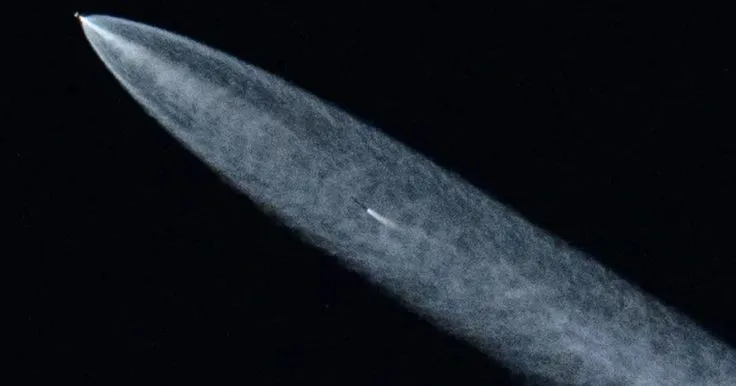
This August, according to calculations, the spent upper stage of SpaceX’s Falcon 9 rocket, founded by Elon Musk, is expected to crash onto the lunar surface near the Einstein Crater. This piece of space debris poses no threat to the Moon or operational spacecraft; however, such incidents raise concerns about the future safety of space infrastructure.
This is reported by Finway
Potential Danger of Space Debris to the Moon
Professional astronomer and near-Earth object monitoring specialist Bill Gray reported that the remnants of the Falcon 9 rocket, which have been orbiting the Earth-Moon system since early 2025, will collide with the Moon’s surface on August 5, 2026, at the boundary of the visible and far sides. Trajectory analysis suggests that the fragment will impact the Einstein Crater at a speed of about 8700 km/h — nearly seven times the speed of sound on Earth.
In 2025, Falcon 9 delivered two lunar landers: the American Blue Ghost from Firefly Aerospace successfully reached the lunar surface in March, while the Japanese Hakuto-R from ispace crashed during landing in June. Since then, the rocket’s remnants have been in orbit at a distance close to that of the Moon from Earth.
Changes in Approaches to Space Debris Disposal
Bill Gray emphasizes that while the current event poses no threat, the situation may become more complicated in the future. In the coming years, the US and China plan to intensify their lunar exploration — Americans plan to send astronauts there annually starting in 2028 and to establish their own base by the early 2030s. China aims to land astronauts by 2030 and build its own base at the Moon’s south pole.
“The rocket’s fall on the Moon this August poses no danger to either the Moon or spacecraft, but this event highlights the need to rethink space debris disposal.”
If permanent bases and infrastructure appear on the Moon, even minor rocket debris could become hazardous to astronauts and equipment. According to scientists, one way to reduce risks could be to change the trajectories of spent stages — for example, redirecting them to orbit around the Sun instead of leaving them in the Earth-Moon system.
It is expected that after the Falcon 9 rocket crashes, a new crater will form on the Moon’s surface, which will hold scientific value for researchers. However, the flash from the impact will remain invisible to Earth observers due to its low intensity. The increase in space activity in the region in the coming years necessitates the development of new approaches to managing space debris to ensure the safety of future missions.

In the photo: Einstein Crater on the Moon, the site of the future Falcon 9 rocket collision