

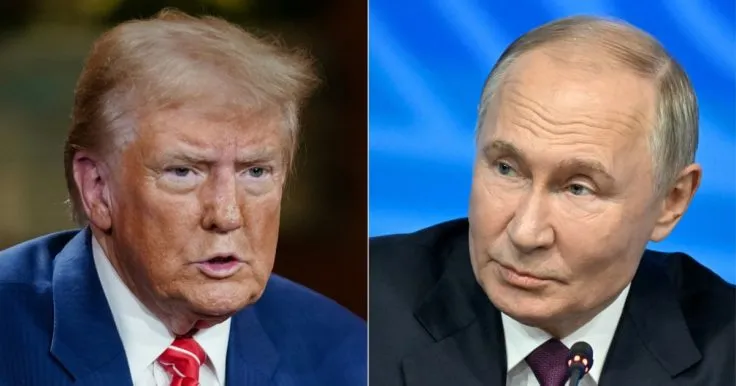
Russian Federation President Vladimir Putin attempted to convince U.S. President Donald Trump during a phone call on April 29 to influence Ukraine into capitulation. This is stated in a report by the American Institute for the Study of War (ISW), which analyzes recent diplomatic and military events.
This is reported by Finway
Russia’s Position and Ukraine’s Reaction
According to ISW information, during the conversation with Trump, Putin reiterated his initial war goals against Ukraine, trying to persuade the American leader that Ukraine’s defense is allegedly weakening and Russia’s victory is inevitable. Putin’s assistant Yuri Ushakov reported that the conversation lasted an hour and a half, during which Putin claimed about Russia’s “strategic initiative” and its advantages on the front. According to Ushakov, the Kremlin would like to achieve its goals through diplomatic means but is prepared to continue military pressure.
In contrast, ISW analysts emphasize that Ukrainian forces have largely halted the advance of Russian troops along the entire front line. Ukraine is effectively restraining the Russian offensive in the spring and summer of 2026, while Russian troops are suffering increasing losses, especially in the Donetsk region, which remains a priority target for Russia.
“Putin again stated that Russia is demonstrating successes on the battlefield to justify its demand for Ukraine’s capitulation. However, the premise of Putin’s assertion remains false. Ukrainian forces continue to prevent Russia from achieving significant advances in several sectors of the front line, particularly in the Donetsk region, which is a priority target for Russia, inflicting increasing losses and damage on Russian troops as a result of these prolonged offensive operations,” the report states.
Experts emphasize that the Russian economy is under significant pressure, losses on the front are increasing, and mobilization is becoming more difficult. The Kremlin seeks to conceal its miscalculations by persuading the West and Trump to pressure Ukraine to achieve goals that could not be attained through military means.
Ceasefire and Diplomatic Initiatives
ISW emphasizes that the ceasefire issue discussed by Trump and Putin is mainly beneficial to Russia—such unilateral ceasefires have previously been used by the Kremlin to accuse Ukraine of violations and to accumulate resources for new attacks. After the conversation with Putin, Trump stated that he urged him to focus on ending the war and proposed a short-term ceasefire. The Kremlin, however, reported that it was Putin who proposed a ceasefire during the celebration of Victory Day on May 9, but the details of this initiative remain unknown.
Ukrainian President Volodymyr Zelensky earlier predicted a difficult period for the state until September. According to the head of state, a possible new trilateral meeting between Ukraine, the U.S., and Russia could occur if the Kremlin chooses the path of de-escalation. Zelensky also noted that an electoral campaign is approaching in the U.S., which will increase political pressure on Ukraine in the summer.
U.S. Vice President Jay D. Vance, during a visit to Hungary on April 8, announced significant progress in negotiations between Russia and Ukraine regarding the cessation of war, indicating that the negotiations concern specific territories on the front. At the same time, Zelensky emphasized that the occupation of Donbas creates a foothold for further aggression by Russia.
Due to the escalation of the situation in the Middle East, trilateral negotiations that took place in January and February were postponed. Meanwhile, the President of Ukraine emphasized that he does not consider these negotiations to be futile.