

A study of the Polymarket market revealed that the majority of profits and accurate pricing on the platform belong to a small circle of experienced traders, while most users incur systematic losses.
This is reported by Finway
Profit Distribution Among Polymarket Traders
According to an analysis conducted by researchers from the London Business School and Yale University, only 3.14% of accounts on Polymarket are classified as “experienced winners.” They are responsible for the majority of accurate pricing, consistently predicting both short-term price changes and the outcomes of events. Together with market makers, this group accounts for over 30% of the platform’s total profit, remaining in the minority.
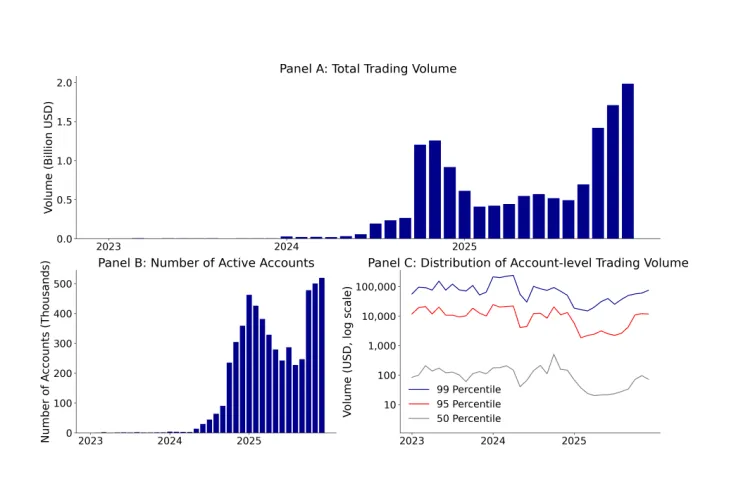
The study examined 1.72 million accounts, 210,322 markets, and approximately $13.76 billion in trading volume from 2023 to 2025.
“About 3% of accounts provide the majority of accurate pricing.”
Most Users Lose Money
Researchers noted that over 67% of users belong to the group of inexperienced or losing traders and effectively finance the profits of a small number of market participants. The authors point out that profit does not always indicate real skills: only 12% of the most profitable accounts overlap with the group of qualified traders.
To distinguish between skill and randomness, 10,000 randomized simulations were conducted for each trader. It turned out that approximately 60% of “lucky winners” lose their profits when tested against new data, while 44% of true professionals maintain their positions over different periods.
Separately, the authors examined insider activity. They identified 1,950 accounts that opened just before significant events and closed immediately afterward. Such traders influence prices 7 to 12 times more strongly for each dollar invested compared to regular experienced traders; however, their activity is limited to isolated cases and does not improve overall market accuracy.
As an example, the study mentions three accounts that placed bets of over $630,000 on the overthrow of Venezuelan President Nicolás Maduro shortly before the start of a military operation. This case coincided with the first investigation by the U.S. Commodity Futures Trading Commission into potential insider activity in the digital asset space.
The researchers’ findings indicate that Polymarket prediction markets reflect the “wisdom of an informed minority” rather than the collective opinion of all users.
