

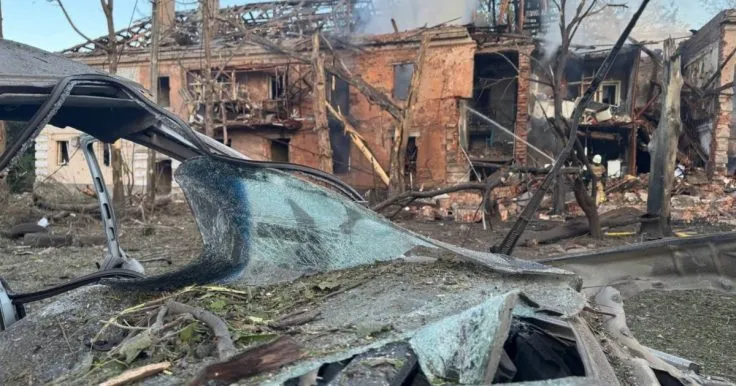
On the night of June 2, the Russian army launched another massive attack on Ukrainian territory, using missiles and drones. Kyiv, Dnipro, and Kharkiv were the most affected, with significant destruction, fatalities, and dozens of injuries among the civilian population.
This is reported by Finway
Situation in Kyiv: Destruction and Fatalities
In several districts of Kyiv, fires and destruction of residential buildings occurred as a result of missile strikes. In particular, debris fell on the roof of a nine-story building in the Podilskyi district, and a subsequent hit led to structural collapse. According to the city mayor Vitali Klitschko, people may remain trapped under the rubble. The number of injured in the capital reached 51, including three children. According to updated data, four people have died.
“In the Podilskyi district, due to a subsequent strike on a nine-story building, there was a structural collapse. There may be people under the rubble,” said city head Vitali Klitschko.
The attacks also caused fires in the Obolonskyi, Sviatoshynskyi, Shevchenkivskyi, and Darnytskyi districts of the capital. In the Kyiv region, according to the head of the regional military administration Mykola Kalashnikov, the strikes were carried out by drones, cruise missiles, and ballistic shells. Three residents of the region were injured and hospitalized.
Losses and Destruction in Dnipro and Kharkiv
In Dnipro, five people died as a result of the Russian shelling, and another 25 were injured. According to the regional administration, 23 of the injured were hospitalized, including a 13-year-old girl with moderate injuries, and three of the wounded are in serious condition.
Kharkiv also suffered a missile strike overnight, with eight people injured in the Slobidskyi district. Seven of them experienced acute stress reactions, and another woman was injured by glass. All received the necessary medical assistance.
Ukrainian President Volodymyr Zelensky emphasized that warnings about the possibility of new massive attacks remain relevant. Russian military forces regularly strike Ukrainian cities and civilian infrastructure using various types of weapons – drones, missiles, KABs, and MLRS, creating a threat to the lives of the entire country.
The Ukrainian authorities, together with international human rights organizations, classify such shelling as war crimes of the Russian Federation. Special attention is paid to targeted attacks on the population’s life support systems – energy, water supply, and medical facilities. Such actions are classified as signs of genocide, as they aim to deprive Ukrainian citizens of the necessary conditions for life.
Experts and human rights defenders emphasize that during the full-scale war, Russia is committing acts that fall under the definition of genocide, including:
- public calls for the destruction of Ukrainians and statements denying the existence of a Ukrainian nation;
- targeted shelling of vital infrastructure;
- persecution and destruction of pro-Ukrainian citizens in occupied territories;
- destruction of Ukrainian intelligentsia and cultural heritage;
- alteration of children’s identities through deportations and changes in the education system;
- seizure of Ukrainian books and theft of historical artifacts.
The Convention on the Prevention and Punishment of the Crime of Genocide, adopted by the UN in 1948, obliges participating countries – currently 149 – to prevent acts of genocide and hold perpetrators accountable in both wartime and peacetime. According to the Convention, genocide is defined as acts aimed at the complete or partial destruction of a national, ethnic, racial, or religious group.
The leadership of Russia denies the facts of targeted strikes on civilian infrastructure and the deaths of civilians, yet evidence and statements from the international community indicate otherwise.