

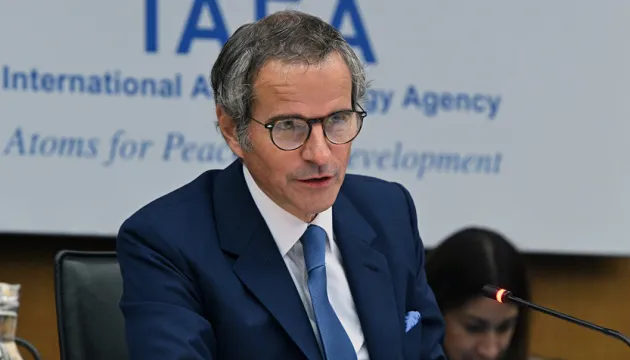
The Director General of the International Atomic Energy Agency (IAEA) Rafael Grossi outlined a key condition for achieving effective agreements between the United States and Iran regarding the Iranian nuclear program in an interview with Al Jazeera.
This is reported by Finway
IAEA’s Role and Challenges in Monitoring Iran’s Nuclear Program
“The IAEA must become a mandatory guarantor that any agreement reached by the parties will be real, not an illusion of agreements. It is necessary to ensure that everything agreed upon on paper will be implemented in practice,” said Rafael Grossi.
Rafael Grossi emphasized that the organization is not a direct party to the negotiations between the US and Iran; however, it maintains separate contacts with both sides to discuss technical aspects. According to him, the oversight of the future agreement’s implementation is currently hindered by damage to several Iranian nuclear facilities due to recent attacks, including those on facilities in Fordow, Natanz, and Isfahan.
The head of the IAEA stressed the importance of unrestricted access for agency inspectors to Iran’s nuclear infrastructure and stockpiles of nuclear materials to monitor compliance with potential agreements.
Challenges for a New Agreement and the Situation with Iranian Uranium
Western countries estimate Iran’s stockpile of uranium enriched to 60% at approximately 440 kilograms. This level significantly exceeds the needs of civilian nuclear energy. Among the possible ways to resolve this situation are both exporting part of the material out of the country and reducing its enrichment level. Grossi noted that transporting uranium in gaseous form is an extremely complex and dangerous task.
The head of the IAEA is convinced that a new agreement regarding Iran’s nuclear program should not replicate the Joint Comprehensive Plan of Action (JCPOA) reached in 2015, as Tehran’s technological capabilities have increased: Iran now possesses more advanced and efficient uranium enrichment technologies than at the time of the previous agreement.
At the same time, Grossi emphasized that Iran’s right to develop peaceful nuclear energy remains indisputable. The country already has a nuclear power plant in Bushehr, and construction of a new power unit is ongoing.