

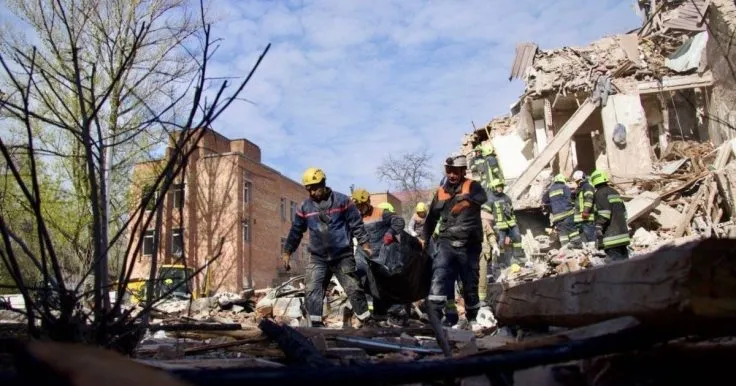
After the recent massive missile strikes by the Russian Federation on Dnipro, 31 injured individuals are currently in local hospitals. Among them are three children: two boys aged 11 and 15, and a 16-year-old girl. This was reported by the head of the Dnipropetrovsk Regional Military Administration, Oleksandr Hanža.
This is reported by Finway
Condition of the injured and assistance to victims
According to Oleksandr Hanža, four patients remain in serious condition, while the others are in moderate condition. As a result of the night shelling on April 25, the death toll has risen to nine people. Earlier, it was reported that eight were killed and at least 56 were injured.
“Four patients are in serious condition. The rest of the hospitalized are in moderate condition,” Hanža added.
To address the consequences of the massive attack, the Ukrainian government will send financial assistance from the state budget to Dnipro. Prime Minister Yulia Svyrydenko noted that the government, in collaboration with the city authorities, is currently assessing the extent of the damage.
Shelling as a manifestation of genocidal actions
President Volodymyr Zelensky linked the increase in the intensity of Russian attacks on Dnipro to the recent unblocking by the European Union of a reparations loan for Ukraine amounting to 90 billion euros.
Russian troops systematically strike Ukrainian cities and civilian infrastructure using various types of weapons: strike drones, missiles, guided aerial bombs, and multiple launch rocket systems. These attacks target the population’s life support systems – electricity, heating, water supply, communication, and medical facilities – and hinder the provision of medical assistance.
Ukrainian authorities and international organizations classify such actions as war crimes of the Russian Federation and emphasize their intentionality. The shelling, which deprives the population of vital conditions, has signs of genocidal actions according to international law.
During the full-scale war, Russia, as human rights defenders and genocide researchers believe, is carrying out actions that may fall under the definition of genocide: public calls for the destruction of Ukrainians, shelling of civilian infrastructure, persecution of individuals with pro-Ukrainian positions, extermination of representatives of the intelligentsia, deportation of children, and destruction of cultural heritage.
According to the Convention on the Prevention and Punishment of the Crime of Genocide, adopted by the UN General Assembly in 1948, signs of genocide include the killing of members of a national group, causing them serious bodily harm, creating living conditions aimed at their destruction, as well as the forced displacement of children.
The leadership of Russia denies that the Russian army is deliberately striking civilian infrastructure and destroying facilities essential for the life support of the Ukrainian population during the full-scale war.