

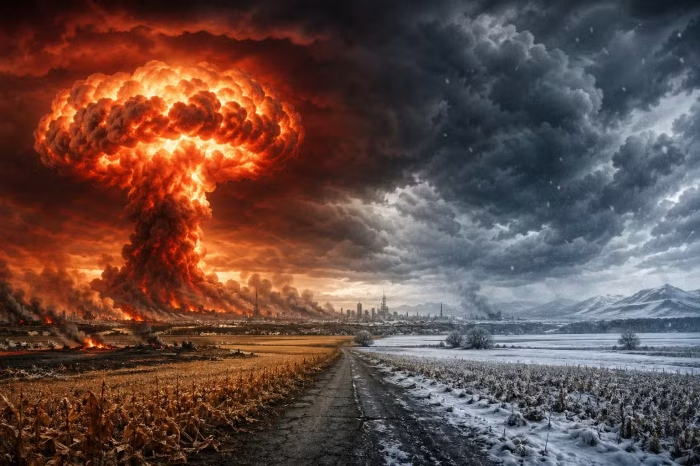
Scientists have developed modeling that demonstrates the potential consequences of a limited nuclear conflict near the Ukrainian-Russian border, which could negatively impact the climate not only of Ukraine but also of many countries around the world. The scenario is not a prediction but provides insight into how local nuclear escalation could become a global climate crisis.
This is reported by Finway
How Nuclear Conflict Will Affect the Atmosphere and Climate
Researchers emphasize that the greatest threat in the event of nuclear explosions comes from large-scale fires in cities, industrial sites, and transportation infrastructure. These fires could release up to 5 million tons of black carbon into the atmosphere. Unlike regular smoke, soot will remain in the stratosphere for an extended period, blocking sunlight and causing a significant drop in temperatures.
Modeling shows that in the first year following such a scenario, the average temperature in the Northern Hemisphere could drop by approximately 1 degree. In some countries, including Russia, a decrease of 5 degrees is possible, while in the USA, it could be 4 degrees. Such temperature fluctuations would significantly shorten the growing season for agricultural crops and create additional risks for energy and transportation.
Long-Term Consequences and Threat to Food Security
Experts warn that the effects of a nuclear conflict in Eastern Europe could last for about 6 years. Soot will remain in the atmosphere, leading to reduced sunlight, uneven precipitation, and disrupted climate conditions in many regions.
For agricultural areas, particularly in Ukraine, this poses a threat to crops: precipitation in key regions could decrease by up to 40%. Crops such as wheat, corn, rice, and soybeans will be at risk, leading to rising food prices and shortages in various countries around the world.
- Expected average cooling of the Northern Hemisphere by 1 degree in the first year;
- Local temperature drops of 4-5 degrees in some regions;
- Reduction of precipitation in agricultural regions by up to 40%;
- Harvest issues and rising food prices;
- Climate disruptions could last for up to 6 years.
“The focus of the research was not on a global exchange of nuclear strikes, but on a limited nuclear conflict in Eastern Europe. That is, a scenario that starts locally but quickly affects the climate far beyond the region.”
Another risk is radioactive contamination. Emissions of long-lived radionuclides, such as cesium-137 and strontium-90, can be carried along with soot particles over long distances, contaminating areas far beyond the epicenter of the explosion.
The concept of “nuclear winter” does not always mean an immediate catastrophe with dark skies. According to scientists, changes will occur gradually: first explosions and fires, then the accumulation of soot in the stratosphere, reduced solar activity, cooling, changes in precipitation patterns, and ultimately serious problems with crop yields and food security.
Ukraine is particularly vulnerable, as it is not only in a zone of heightened nuclear risk due to the war and the occupation of the Zaporizhzhia Nuclear Power Plant but also remains a key player in the global grain and oilseed market. The climatic impact on Ukrainian agriculture could be felt worldwide.
Thus, even a limited nuclear conflict near the borders of Ukraine and Russia poses a threat to the global climate, food security, and economic stability worldwide.