

Sam Rutherford, an experienced civilian pilot, along with co-pilot Shannon Wong, was flying a Piper PA-28 light aircraft when they unexpectedly found themselves in the midst of military operations over the Arabian Sea. At that time, a large-scale US military operation against Iran, named “Epic Fury,” was beginning.
This is reported by Finway
Encounter with American Military Power
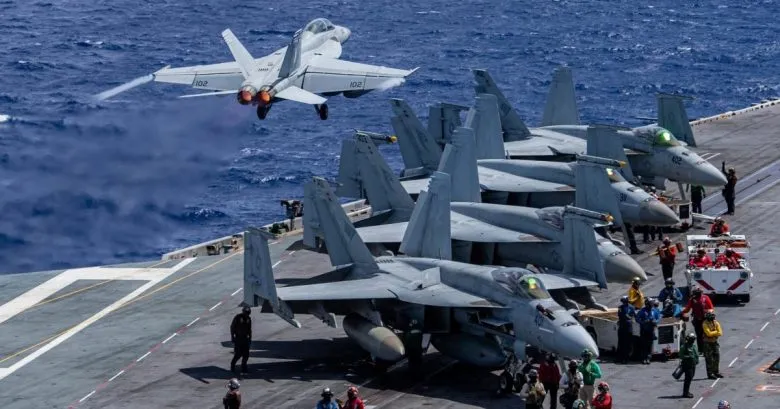
While flying south of Iranian territory, the pilots were listening to music when suddenly an American fighter jet appeared next to their small aircraft. The US military demanded that the crew of the Piper PA-28 establish communication. According to Rutherford, in a video he posted on Instagram, a fighter jet was seen approaching their aircraft, which he later clarified was an F/A-18 Hornet.
“We were just buzzed by an F-16,” says a surprisingly calm Rutherford in the video capturing the moment, which was published on Instagram. He later clarified in his post that it was actually an F/A-18 Hornet.
On the aircraft’s radio, calls from other airliners could be heard as they sought a safe place to land, as the Persian Gulf had already become an active combat zone. Most passenger planes landed in the capital of Oman, Muscat—a typically quiet airport. Sam Rutherford also decided to land there, bringing the Piper PA-28 from Florida to a flight school in India.
Dangerous Route Choice and Military Intervention
The day after the incident, Oman’s airspace was reopened, and Rutherford decided to continue his journey to Ahmedabad, India, over the Indian Ocean. He noted that atmospheric tension was rising, so he made the decision to leave the region immediately and embark on a 1450-kilometer flight.
About three hours after takeoff, Iran launched a missile strike on Oman, leading to the closure of airspace, and the presence of the Piper PA-28 in the sky attracted the attention of American military forces. Due to technical reasons, communication with the military fighters was lost, creating a tense situation.
The pilots were offered to change course by 15 degrees north or south, as their route was heading directly towards an American aircraft carrier. Rutherford emphasized that neither of the proposed options was safe: to the south was open ocean with the risk of running out of fuel, and to the north was Iranian or Pakistani airspace, which was inaccessible.
While the military situation was being resolved, two F/A-18 fighters continued to patrol around the Piper PA-28 for another half hour. Finally, a compromise was reached with the US Navy, and the aircraft was allowed to continue its flight, avoiding potential danger.
Rutherford ironically noted that the military was escorting them to ensure there was no threat to their assets, and he successfully completed his flight, delivering the aircraft to India. In the future, he plans new flights, not ruling out a repeat encounter with the American military.
In response to inquiries about this incident, US Central Command stated that they currently have no additional information. Meanwhile, Iran threatened to attack American ships in the event of an attempt to block the Strait of Hormuz.