

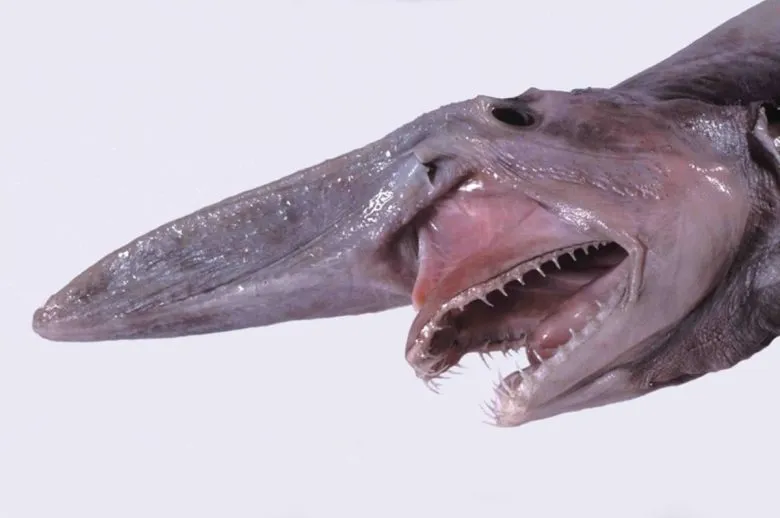
The goblin shark is considered one of the most astonishing and least attractive marine creatures, captivating the imagination of researchers with its unique features. Its particularly notable characteristic is its unusual jaw structure, which can shoot forward like a slingshot to catch prey even at a considerable distance.
This is reported by Finway
Features and Lifestyle of the Goblin Shark
Goblin sharks inhabit the depths of the ocean, typically at depths of over 100 meters, making encounters with them extremely rare for humans. This species is known for its exceptionally unappealing appearance and hunting method. They do not possess remarkable swimming speed, so they hunt using their rapid, extendable jaws, which allow them to instantly capture their prey.
The lifespan of a goblin shark, according to biologists, can reach approximately 60 years. This enables these creatures to maintain their population even in the challenging conditions of the deep-sea environment.
“Although humans rarely see them and they are not well studied, their hunting technique has fascinated people around the world. Since they are not particularly strong swimmers, these sharks rely on their quick, extendable jaws, which shoot out from their mouths like a catapult to devour prey before it has a chance to escape,” the material explains.
Appearance, Size, and Habitat
The appearance of the goblin shark is indeed astonishing: its body is soft and colored in grayish-pink tones due to the blood vessels that shine through its translucent skin. The elongated, flat snout draws particular attention, resembling the sharp nose of a witch, as well as its small, sharp teeth.
Typically, the length of these sharks reaches about 4 meters; however, it is known that some individuals can grow up to 6 meters and weigh approximately 210 kg.
Goblin sharks are found in the deep waters of the Atlantic, Pacific, and Indian Oceans, most commonly near continental shelves and underwater mountains. They can be encountered at depths ranging from 100 to 1300 meters, and sometimes even at depths exceeding 2000 meters, where researchers have captured them on video.
The diet of these predators primarily consists of bony fish, cephalopods, and various crustaceans.
Regarding the danger to humans, these sharks live so deep that the chance of encountering them is virtually nonexistent. However, it is known that they can bite through fiber optic cables on the ocean floor, which sometimes leads to internet connectivity issues in coastal regions.