

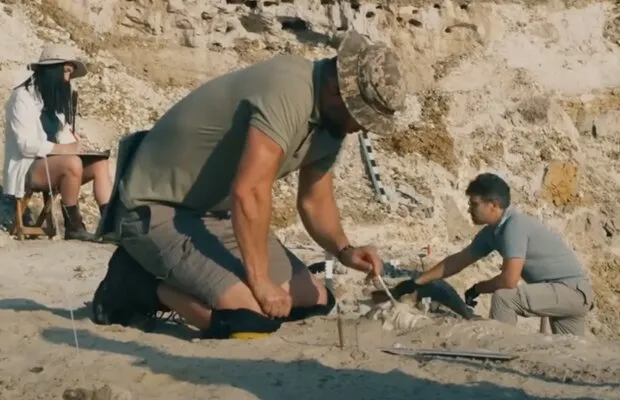
Archaeologists have recorded unique footprints of humans and animals on the eastern coast of Scotland, in Lunan Bay, dating back approximately two thousand years.
This is reported by Finway
The discovery was made possible by a storm that exposed a clay layer with well-preserved tracks. Local residents were the first to notice the unusual prints, after which specialists joined the research efforts.
Documenting Under the Threat of Time
The team of archaeologists worked tirelessly, as each tide could destroy the valuable tracks. The scientists themselves described their work as a true “race against time,” noting that their prompt response allowed them to preserve unique artifacts for further study.
“Race against time.” Tides could obliterate the tracks within hours, so the archaeological team worked continuously to capture each footprint. This enabled the preservation of unique material that opens new chapters in the life of the Roman era in Scotland.

The Significance of the Discovery for History
The discovered tracks are exceptionally rare artifacts, as they provide a “snapshot” of everyday life during that era. Unlike traditional archaeological finds, such as fortifications or pottery, the footprints allow us to trace the movements and presence of humans and animals at a specific moment in time.
- The preservation of tracks for millennia is an extraordinarily rare phenomenon.
- They serve as direct evidence of human activity on the coast during the Roman era.
- The footprints may indicate trade, movement, or even military presence in the region.
Researchers are convinced that the discovery at Lunan Bay offers a new perspective on Scotland’s Roman heritage. The coast emerges not only as a site for defensive structures but as a space of vibrant everyday life. Further archaeological work is expected to clarify whether the tracks were left by local inhabitants, Roman soldiers, or traders.
This discovery once again emphasizes the importance of timely actions by archaeologists, as even a single wave can erase unique evidence of the past. The findings at Lunan Bay have already been recognized as one of the most valuable in the study of Roman heritage in Britain in recent years.