

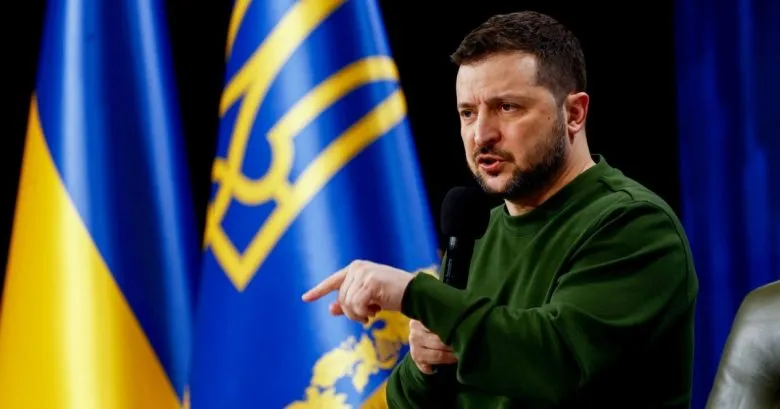
President Volodymyr Zelensky announced that Ukraine expects to receive funds from the reparations loan as early as the beginning of 2026. During a conversation with journalists, he emphasized that the final timeline depends not only on the Ukrainian side but also on a number of external factors.
This is reported by Finway
Willingness to Engage in Dialogue and Main Areas of Fund Utilization
Zelensky noted that the Ukrainian authorities understand who may block the provision of the loan and are ready to work with these individuals, even if “some of them are not even willing to listen.” At the same time, the number of such individuals, in the president’s opinion, is not significant.
“We need them (the funds – ed.) in 2026; it would be better to receive them at the very beginning of the year. But I don’t know if that is possible. Not everything depends on us – some things depend on others, which is good, but not everything,” he stated.
According to the head of state, the main focus of spending will be on the development of Ukrainian defense production. Priority areas will include long-range weapons, drones, electronic warfare systems, and missiles. Ukraine’s annual capabilities for drones and missiles alone amount to about 35 billion hryvnias, but currently, significantly less is being utilized. The main part of the loan is planned to be directed towards this component.
The Role of Frozen Russian Assets and European Support
Zelensky separately emphasized that the funds will also go towards joint defense production with Europe and air defense systems to protect against ballistic threats. Ukraine hopes that the decision to use frozen Russian assets will become one of the effective means of pressure on Russia, which, according to the president, “is very afraid” of such a development. He characterized the discussion among EU leaders on this issue as “challenging but very good.”
It is expected that EU leaders will adopt a positive political decision that will allow for financial assistance to Ukraine using the frozen resources of the Russian Federation in the form of a reparations loan.
Belgian Prime Minister Bart De Wever stated that he is awaiting legal grounds for implementing such a loan. Currently, over 180 billion euros in assets are frozen in Belgium’s central depository, Euroclear. These funds became unavailable to Russia due to EU sanctions in response to its invasion of Ukraine.
The essence of the scheme is that cash received from Russian central bank bonds can be transferred to the EU, which will enter into an individual debt contract with Euroclear at 0% interest. Brussels plans to use these resources to finance the loan to Ukraine, which, in turn, will only have to repay it in the event of receiving compensation from Russia for damages incurred. In Russia, this idea has been labeled as “pure theft.”
In response to the potential seizure of its assets abroad, on September 30, Russian President Vladimir Putin signed a decree establishing a new procedure for the sale of federal assets. According to Bloomberg, Russia is preparing to nationalize and rapidly sell foreign assets in response to such actions.