

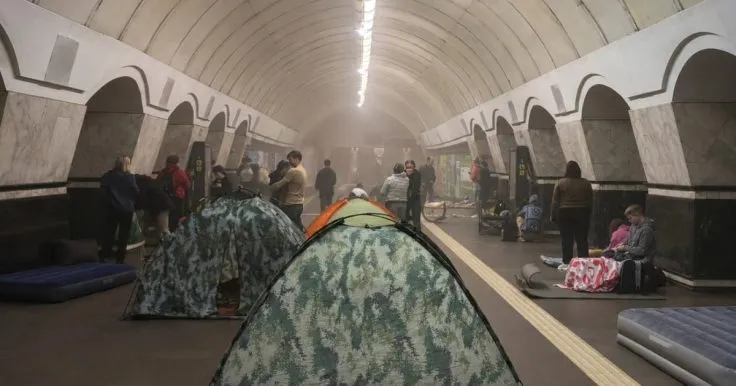
On May 24, in Kyiv, after a massive missile strike by the Russian Federation, the “Lukyanivska” metro station and the parking lot of the “Trinity” residential complex were damaged. These events raised questions among residents about safe shelters during new attacks, especially in light of the threat of repeated airstrikes, which were publicly announced by the Kremlin.
This is reported by Finway
Consequences of the strikes and the reliability of shelters in metro stations and parking lots
The “Lukyanivska” station, located at a depth of 69 meters, suffered damage: smoke appeared, and decorative elements began to fall from the ceiling. At the “Trinity” residential complex, a missile penetrated the parking lot ceiling, damaging vehicles. According to President Volodymyr Zelensky, about 300 buildings of various purposes were affected in the capital, including residential buildings, shops, and warehouses.
Security expert Ihor Molodan emphasized that shelters in metro stations and underground parking lots remain the safest places even during massive strikes. Experience from previous attacks shows:
“no one has died despite the hits.”
Molodan explained that there are types of weapons capable of hitting targets at depths of up to 30 meters and even penetrating metro ceilings. At the same time, he noted that the Russian military used powerful missiles, as if less powerful means, such as “Shaheds” or smaller missiles, had been used, there would not have been such significant destruction. Despite this, underground parking lots and metro stations remain the most reliable shelters for civilians.
Which shelters to choose and how to act during shelling
According to the expert, in situations of threat, it is not advisable to succumb to emotions due to news of destruction, but rather to rely on statistics. In both cases, despite the damage to infrastructure, no casualties among people were recorded. This confirms that shelters in metro stations and parking lots remain safe for staying during shelling.
Ihor Molodan emphasized that such shelters can be metro stations or dual-purpose facilities. He urged not to ignore air raid signals, even if there have been no shelling for a long time. According to him, it is best to immediately go down to the underground shelter, as during ballistic missile strikes, the “two walls” rule does not provide adequate protection.
The expert concluded that being in a specialized shelter is significantly safer than staying in one’s own apartment, even in the bathroom or hallway on one of the upper floors of a high-rise building.
During the strike on May 24, damage was recorded in all districts of Kyiv. In the first hours after the attack, two fatalities were reported, and later the number of victims rose to three. As a result of the shelling, the Lukyanivskyi market was burned down, part of a five-story building was destroyed, and fires broke out in high-rise buildings.
According to the Air Forces of the Armed Forces of Ukraine, Russia used about 700 means of destruction, of which 650 were strike drones of various types, as well as 50 missiles, including “Iskanders”, “Zircons”, “Kalibrs”, X-101, and one UAV “Oreshnik”.
The Ministry of Foreign Affairs of the Russian Federation publicly issued threats to Kyiv that day and identified the facilities that are under the greatest danger during air attacks.