

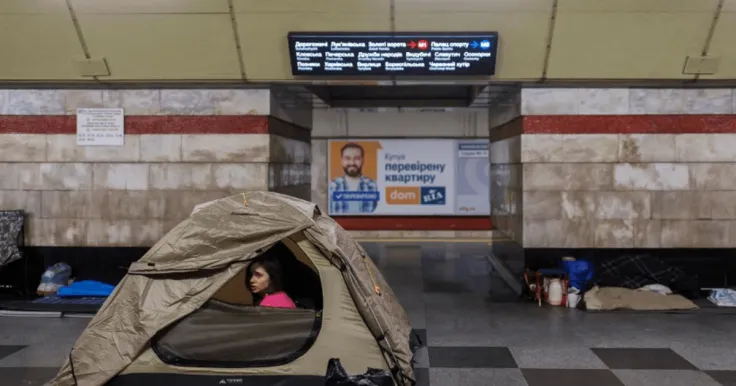
After the recent massive attack on Kyiv, public attention has focused on the conditions for people in the capital’s metro, which serves as a shelter during air alerts. The emergence of tents at stations has sparked particular discussion, as experts say it not only creates discomfort for other passengers but can also lead to dangerous situations in the event of a mass gathering of people.
This is reported by Finway
Safety and comfort in the metro during martial law
Engineer and urbanist Dmytro Makahonov believes that the capital’s metro should revise the rules for staying at stations in light of new realities. Metro stations now serve not only a transportation function but also a protective one, so the existing rules, developed for peacetime, no longer meet the needs of wartime. According to the expert, it is necessary to clearly zone the space, define areas for passage, rest, and accommodation of people during prolonged air alerts.
Makahonov emphasizes that tents and similar structures can significantly complicate evacuation during new attacks, cause panic, or even lead to crushes. He is convinced that the metro should take responsibility for solving this problem:
«It would be reasonable for the metro to provide more seating during the use of stations as shelters. Then the need for tents would be significantly less,» the expert explains.
At the same time, the urbanist notes that the appearance of tents is a understandable reaction from people who are forced to spend several hours underground with children and families and are trying to make their stay more comfortable. At stations with a small number of people, tents do not create significant problems, but at key stations with hundreds of visitors, stricter restrictions are needed, in his opinion.
Infrastructure issues and sanitary conditions
The expert reminded that at the beginning of the full-scale invasion, Kyiv residents “jammed” places in the metro, leaving tents at stations for extended periods—even when they were absent themselves. As one solution to the lack of seating, Makahonov suggests using metro cars: at some stations, trains could be left overnight with open doors, which was already practiced in 2022.
The expert pays special attention to sanitary conditions. According to him, modern requirements for shelters provide for more toilets and facilities than the current stations have. Although many stations were designed as protective structures, today their infrastructure does not fully meet the needs of large numbers of people who are underground for several hours at a time.
If Russian attacks intensify, or if people spend longer in the metro, the issue of modernizing the stations will become particularly relevant. The expert believes that the city should already invest resources in the development of shelter infrastructure, as the protective function of the metro in wartime has become just as important as its transportation function.
Regarding future metro stations in Vynohradar, Dmytro Makahonov emphasized the need to design them with the possibility of full use as shelters for the population. He even suggests that it may be advisable to build a station without a tunnel if it allows for better fulfillment of the protective function.
The Kyiv City Military Administration has already responded to complaints about overcrowded metro and the installation of tents that take up space. The KMVA stated that they are considering the possibility of introducing restrictions and urged residents to be tolerant of the need to provide space for as many people as possible in shelters.
It is worth noting that during the air alert that night, about 41,000 people were in the capital’s metro, including about 10% children. The municipal enterprise emphasizes that stations switch to shelter mode only during alerts, and passengers are advised to follow the rules and not bring bulky items into the metro.