

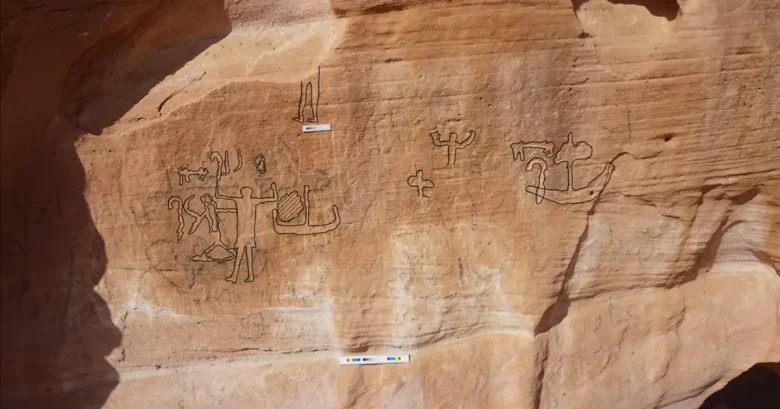
In the Sinai Desert, archaeologists have made an important discovery — an ancient rock painting estimated to be around 5,000 years old has been found. According to researchers, this artifact is one of the earliest examples depicting the establishment of military and political power of Ancient Egypt over other territories.
This is reported by Finway
Historical Significance of the Find
In 2025, during archaeological work, the panel was discovered by Mustafa Nour El-Din, who works at the Aswan inspection of Egypt’s Ministry of Antiquities. Scientists believe that the discovered painting may only be a fragment of a larger complex of images. This opens up prospects for further extensive research in this region.
The stone depicts a dynamic scene: one man with raised arms, symbolizing victory or divine triumph, stands next to another figure — a kneeling person with an arrow in his chest and bound hands. The composition is complemented by a boat and an inscription in which the god Min is referred to as the “lord of the copper land.”
Symbolism of the Image and Historical Context
Researchers interpret the boat as a symbol of the state power of Egypt or the ruler himself, while the figure of the victor is identified with the god Min. The wounded and bound person likely represents the local population of Sinai. Such an image reflects the act of violent subjugation of the region by Ancient Egypt.
Similar rock images have already been found on the Sinai Peninsula, confirming that during this period, the Egyptians were actively expanding their influence in the southwestern Sinai. The primary reason for the expansion was the interest in natural resources, particularly copper and turquoise deposits, which were strategically important for the development of the state.
At that time, Sinai was predominantly inhabited by nomadic tribes. Professor of Egyptology at Bonn University, Ludwig Morenz, notes that the discovered panel is one of the earliest artistic evidences of the establishment of political control over foreign lands.
“The discovered panel is one of the earliest artistic testimonies to the establishment of political control over other lands,” emphasized Professor Ludwig Morenz.
Particular attention is drawn to the damaged inscription near the boat, which likely contained the name of a specific ruler. Archaeologists suggest that it was deliberately erased, and the reason for this remains unknown. In the history of Egypt, there have been numerous instances of deliberate destruction of names following a change of power.
This rock painting not only expands knowledge about the early conquests of the Egyptians but also demonstrates how openly scenes of violence, victory, and political power were depicted in ancient times.