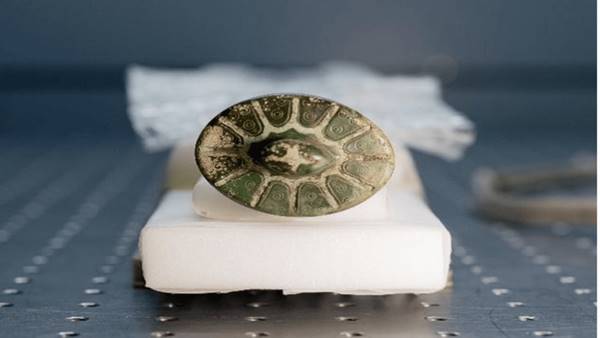
Near the Bavarian city of Nördlingen, archaeologists conducted a detailed study of a type of sword known as Achtkantschwert, created around 1400 BC. This 3400-year-old artifact is distinguished by the characteristic “red-golden” sheen of its blade, which, as analysis showed, was achieved through copper inlays and a specially created chemical patina.
This is reported by Finway
Methods for Studying the Ancient Sword
Modern non-destructive technologies were employed to study the unique sword. In particular, synchrotron radiation at the BESSY II facility in Helmholtz-Zentrum Berlin enabled high-precision X-ray scanning. Additionally, computer tomography allowed for the construction of a three-dimensional model of the artifact’s internal structure. It was found that the blade transitions into the hilt through a tang secured with rivets, which is considered a technologically complex solution for the Bronze Age.
“Archaeologist Beate Herbold noted that the production of such swords required exceptional craftsmanship.”
Copper Inlays and Technological Features
Initial hypotheses suggested the possible presence of tin inserts in the hilt; however, X-ray analysis disproved this assumption. It turned out that the inlays were made from thin copper wire. This approach indicates a high level of metallurgical development during that period. Thanks to the contrast of reddish copper and golden bronze, enhanced by the chemical patina, the sword acquired a particularly striking appearance.
Researcher Johann-Friedrich Tolksdorf noted that while similar copper inlays are found in other archaeological discoveries, in this case, they were executed with exceptional finesse.
Octagonal swords are considered one of the most prestigious artifacts of their time. The complexity of their manufacture, casting, and decoration indicates that such items belonged to the elite of the Bronze Age. The sword served not only a combat function but also symbolized status and power, underscoring its decorative program.
The research confirms that Bronze Age craftsmen possessed complex technologies and consciously aimed to create impressive aesthetic effects. The use of modern scientific methods—from synchrotron analysis to three-dimensional tomography—allowed for the exploration of the sword’s production features without damaging its structure.