

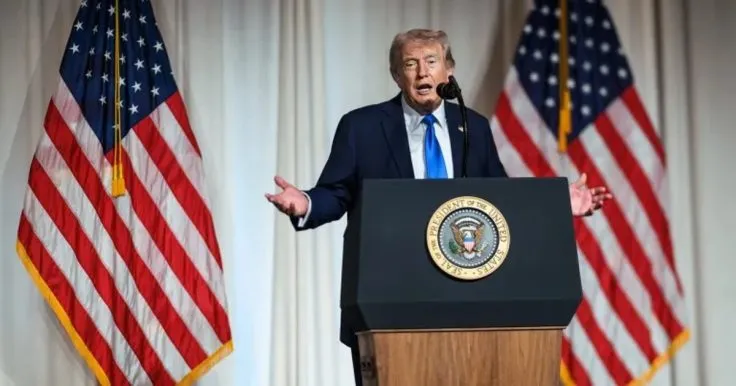
The White House has informed the U.S. Congress about the end of the military conflict with Iran, despite the ongoing presence of American troops in the Middle East. An official letter from President Donald Trump’s administration, sent on May 1, states that hostilities between the U.S. and Iran have ceased, and it was delivered to House Speaker Mike Johnson and acting Senate President Chuck Grassley.
This is reported by Finway
The White House’s Position and Congressional Reaction
In his message, the president justified why the deadline set by law for obtaining Congressional approval for the continuation of hostilities is no longer relevant. According to the War Powers Resolution of 1973, Congress was required to declare war or authorize the use of force within 60 days, or grant a 90-day extension at the president’s request. However, the Senate has already rejected attempts by Democrats to stop the war six times, and as a result, Congress has taken no action on this matter.
The Trump administration claims that with the onset of a ceasefire in early April, the conflict is effectively over, and the legal timelines no longer apply. At the same time, Senate Majority Leader John Thune publicly stated that he does not plan to bring to a vote the issue of authorization for the use of force in Iran or any related matters.
“Hostilities that began on February 28, 2026, have ceased,” Trump wrote to House Speaker Mike Johnson (Republican from Louisiana) and Senator Chuck Grassley (Republican from Iowa), the acting Senate President.
Real Consequences and Assessment of the Situation
Despite the announcement of the end of the conflict, President Trump emphasized in his letter that the threat from Iran to the U.S. and American military personnel remains significant. This is corroborated by analysts who note that Iranian forces still control the Strait of Hormuz, while the U.S. Navy maintains a maritime blockade to prevent Iranian oil tankers from entering international waters. Currently, the U.S. has already spent over $25 billion on the war.
The political situation in Congress is marked by the reluctance of Republican lawmakers to confront the president on the issue of war. This occurs during a period of rising public discontent with both the conflict itself and the impact of the war on fuel prices. Most Republicans in Congress tend to support Trump’s policy or at least grant him additional time under the ceasefire.
Additionally, Iranian media recently released a video created using artificial intelligence, showing missile strikes on Ukraine, raising concerns among international experts about the potential for information influence from Iran.