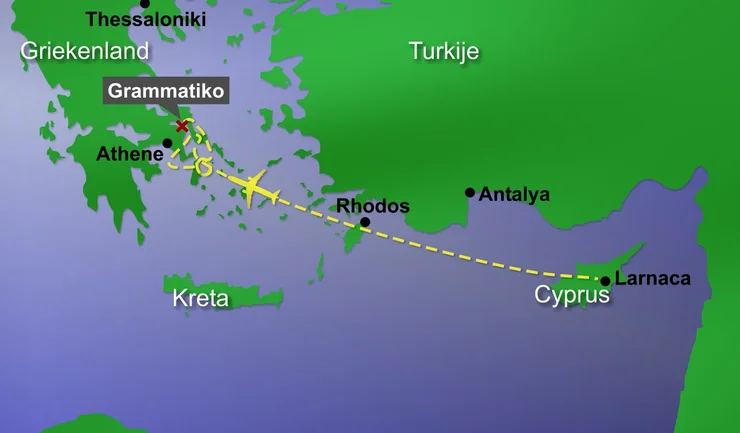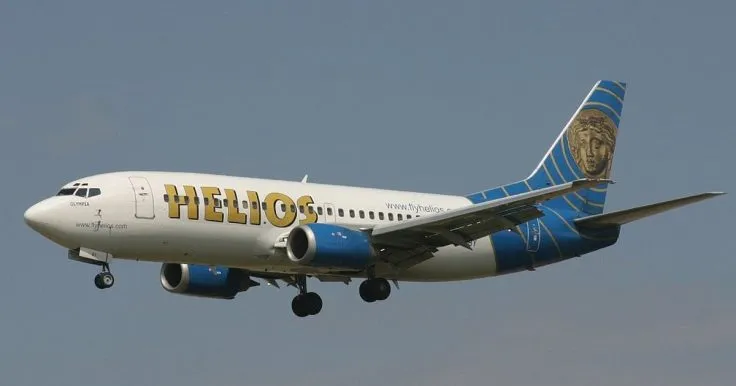
The largest aviation disaster in the history of Greece involved a Boeing 737 aircraft on flight 522 of the Cypriot airline Helios Airways. The crash claimed the lives of 121 people when the plane flew for over three hours without crew control and crashed into a mountain near the village of Grammatiko.
This is reported by Finway
Tragic Flight: Sequence of Events
On August 14, 2005, at 9:00 AM local time, the Boeing 737 departed from Larnaca (Cyprus) to Athens (Greece), with a subsequent flight to Prague (Czech Republic). Landing in Athens was mandatory; however, just 17 minutes after takeoff, the crew stopped communicating. Around 10:00 AM, the aircraft entered Greek airspace, but the controllers were unable to establish contact with the pilots.
At 11:00 AM, two Greek Air Force F-16 fighter jets approached the aircraft. The pilots discovered that all passengers and crew in the cabin were unconscious in oxygen masks, indicating serious problems on board. Efforts by the controllers to establish contact for an hour were unsuccessful.
The only person who remained conscious was flight attendant Andreas Prodromou. He had a pilot’s license and was using a portable oxygen tank, but he could not manage and land the Boeing 737 without training for such a type of aircraft.
“Prodromou waved to the F-16 pilots from the cockpit window, tried to wake the pilots of the Boeing 737, and even sent several distress signals, but it was already too late.”
The aircraft’s engines stopped due to fuel exhaustion, and around 12:00 PM, it crashed into a mountain near the village of Grammatiko. Everyone on board perished.
Causes of the Tragedy and Investigation Results
The investigation confirmed that the cause of the disaster was a combination of fatal errors by the crew and ground personnel. The day before, the crew reported a cabin pressurization malfunction, so the system was switched to “manual” mode for inspection. After the malfunction was resolved, they forgot to return it to “automatic” mode, which became a critical moment during flight preparation.
Just 15 minutes after takeoff, a decompression alert sounded in the cockpit, but the pilots confused it with a warning about incorrect takeoff configuration and did not take the necessary actions. This led to a rapid decrease in oxygen levels on board, causing all individuals to lose consciousness due to hypoxia.
After this, the aircraft remained in the sky on autopilot for nearly three hours until the fuel ran out and the tragedy occurred. The crash of flight 522 became one of the saddest chapters in aviation history, prompting airlines worldwide to review pre-flight preparation procedures and cabin pressurization system controls.