

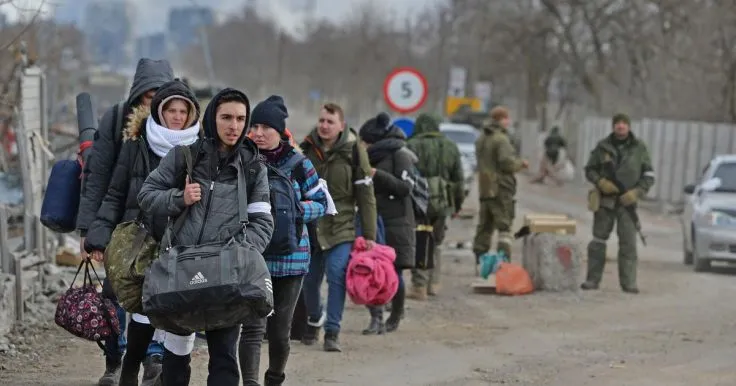
Russia officially establishes an internal administrative border between the Rostov region and the temporarily occupied parts of Donetsk and Luhansk regions of Ukraine. This move contradicts the Kremlin’s statements about the “full integration” of these regions into the Russian Federation.
This is reported by Finway
Official border formalization and movement restrictions
In May 2026, the governor of the Rostov region, Slyusar, submitted the relevant bills to the local legislative assembly. The profile committee has already approved these agreements, and final approval is expected on May 28, 2026. In total, the length of the border between the Rostov region and the occupied territories of Donbas is about 660 km, of which over 400 km runs overland. In particular, the section of the border with occupied Luhansk reaches 492 km, while with Donetsk it is 178 km.
The border follows the Soviet-Ukrainian administrative landmarks: through the floodplains of the Mius, Krynka, Mokryi, and Sukhy Yelanchik rivers, as well as through ravines and forested areas. Despite the propaganda about a “single space,” a strict FSB regime operates at these borders, with baggage X-rays, inspections, long queues, and interrogations. At the same time, the occupiers are gradually isolating the occupied territories: the Voronezh region has restricted entry from occupied Luhansk, leaving only one crossing point.
Reasons for increased control and isolation of occupied territories
“New territories” are an enclave, worse even than Chechnya, considering the amount of weaponry and the absence of a legal regime. This led to the creation of a 5-kilometer zone in 2024.
Since May 2024, a special 5-kilometer zone has been in effect at the border of Russia with these territories to restrict free movement between the subjects of the federation and the occupied regions of Donbas. Official crossing is allowed only through designated checkpoints, and a special entry regime is in place.
The reason for such measures is the Russian authorities’ awareness of the uncontrolled flow of weapons, explosives, and the illegal movement of so-called “new citizens” of Russia without proper customs control. The occupied territories have turned into a “black hole” exploited by criminal groups for drug trafficking, psychotropic substances, and car smuggling.
The Russian authorities also aim to prevent the infiltration of agents from Ukrainian special services across this border. Therefore, the movement of Ukrainian citizens, including residents of temporarily occupied territories, is restricted to a single crossing point in Sheremetyevo, controlled by Russian special services.
Additionally, Donbas has historically been a center for the production of counterfeit alcohol, tobacco products, as well as a place for the uncontrolled circulation of weapons and excise goods. The increase in control is intended to protect Russian regions from the further spread of weapons, explosives, and deserters from the combat zone.