

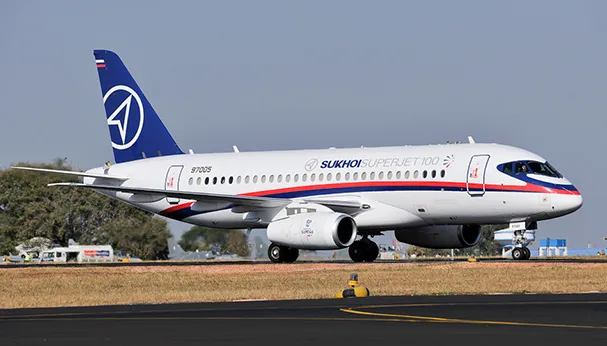
The Ministry of Industry and Trade of the Russian Federation has announced a tender to extend the operational lifespan of Sukhoi Superjet 100 aircraft. This move indicates a deep crisis in the revival of domestic aircraft manufacturing, as key modernization programs for the fleet have effectively been disrupted.
This is reported by Finway
Certification Issues and the Failure to Update the Fleet
Within the framework of the aviation industry development program approved in 2022, it was planned to deliver 42 updated SSJ100s to airlines by 2030, but only 12 aircraft have been delivered to date. The main reason is the lack of certification for the new Russian PD-8 engine, without which it is impossible to start serial production of the upgraded aircraft. A similar situation has arisen with other models that were planned to replace the foreign fleet: MC-21, Il-114-300, Tu-214, Il-96-300. During this time, airlines have only received one additional Tu-214, although it was initially planned to produce up to 200 new aircraft per year.
Instead of New Aircraft — Prolonged Operation of Old Ones
Instead of renewing the fleet, the Russian agency proposes to extend the operation of existing machines. It is planned to increase the maximum number of flight cycles for the SSJ100 from 10–15 thousand to 15–20 thousand, the allowable flight hours from 15–25 thousand to 25–40 thousand hours, and the service life of certain versions from 15 to 20 years. However, the contract amount of $60.6 million is insignificant for the scale of aviation, so it is essentially a formal extension of the lifespan with minimal technical changes.
Currently, about 159 SSJ100s are in operation, nearly half of which are in the fleet of the airline “Russia” from the “Aeroflot” group. A significant portion of these aircraft is equipped with SaM146 engines, produced by the Franco-Russian company PowerJet. After the French company Safran exited Russia in 2022, support and maintenance for these engines became problematic, and the tender documentation does not provide explanations on how this issue will be addressed.
Additional difficulties have arisen due to the position of the Russian company “ODK-Saturn,” which owns half of the rights to the SaM146 engine but refuses to acknowledge itself as its developer. As a result, it is impossible to carry out major repairs and approve changes to the documentation in Russia. Currently, “ODK” only supports modifications by updating service bulletins but does not take responsibility for extending the lifespan or performing major repairs on the engines.
“Extending the lifespan of the SSJ100 is not a technical solution, but a way to conceal a disaster. Russia cannot build new aircraft in the required quantities, so it pays for the opportunity to keep old ones flying longer. The longer these machines are in the sky, the higher the risk for passengers and the more evident the failure of what the Kremlin once called a program of technological sovereignty,” intelligence officials noted.
Changes in plans have also manifested in the adjustment of target indicators: while the Russian Federation previously projected that by 2030, national aircraft would make up 80% of the fleet, this figure has now been reduced to 50%. The actual share of domestic aircraft in the fleet as of May 2026 is only 19%, and by the end of the year, it may reach 20%.