

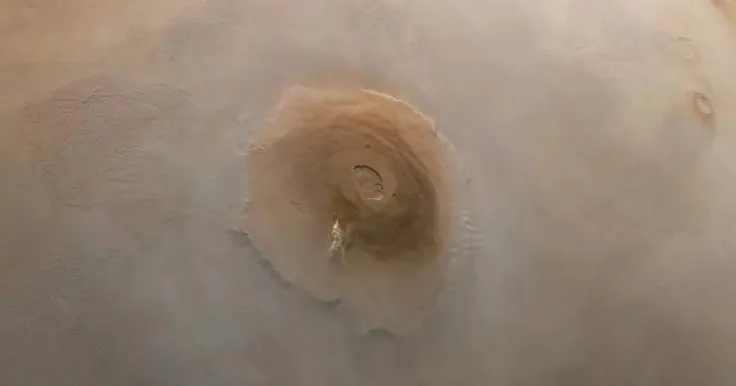
Olympus Mons, located on Mars, is the tallest volcano and mountain in the entire Solar System. Its height reaches approximately 21 kilometers, which is three times the height of Mount Everest on Earth. The diameter of the base of the volcano is about 600 kilometers, and its area is nearly equal to that of Poland, measuring approximately 300,000 square kilometers.
This is reported by Finway
Geological Past and Unique Scale of Olympus
According to scientists, Olympus Mons formed over 3.5 billion years ago. Eruptions of this shield volcano lasted quite a long time: estimates by planetary scientists suggest that activity could have persisted as recently as 25 million years ago, while some studies even propose it could have been as recent as 2 million years ago. During this period, the first ancestors of humans had already appeared on Earth.
Olympus impresses not only with its size but also with its structural features. Due to its extremely gentle slopes, when standing at the summit of the volcano, the horizon would be only three kilometers away due to the curvature of Mars’ surface. The scale of this mountain is so vast that standing at its peak, it is difficult to comprehend its dimensions.
“Olympus Mons is so enormous and high that you wouldn’t be able to gauge its scale while standing at its summit. The slope is so gentle that even if you were at the top of the volcano, the horizon would be no farther than 3 kilometers. This is due to the curvature of the planet’s surface.”
Unexpected Discoveries at the Summit of the Volcano
Olympus Mons is located near the equator of Mars, where increased solar activity and higher temperatures are observed. This is why scientists were surprised when an ice cap was discovered at the summit of the volcano. Researchers had previously believed that under such conditions, water ice could not form at such heights near the equator. This discovery raised new questions about the characteristics of the atmosphere and climate on Mars, as well as the mechanisms of ice formation at the summit of Olympus.
The uniqueness of Olympus Mons continues to attract the attention of scientists and inspires new space research. New photographs taken by the Mars Express spacecraft allow us to once again appreciate the scale and uniqueness of this Martian volcano.