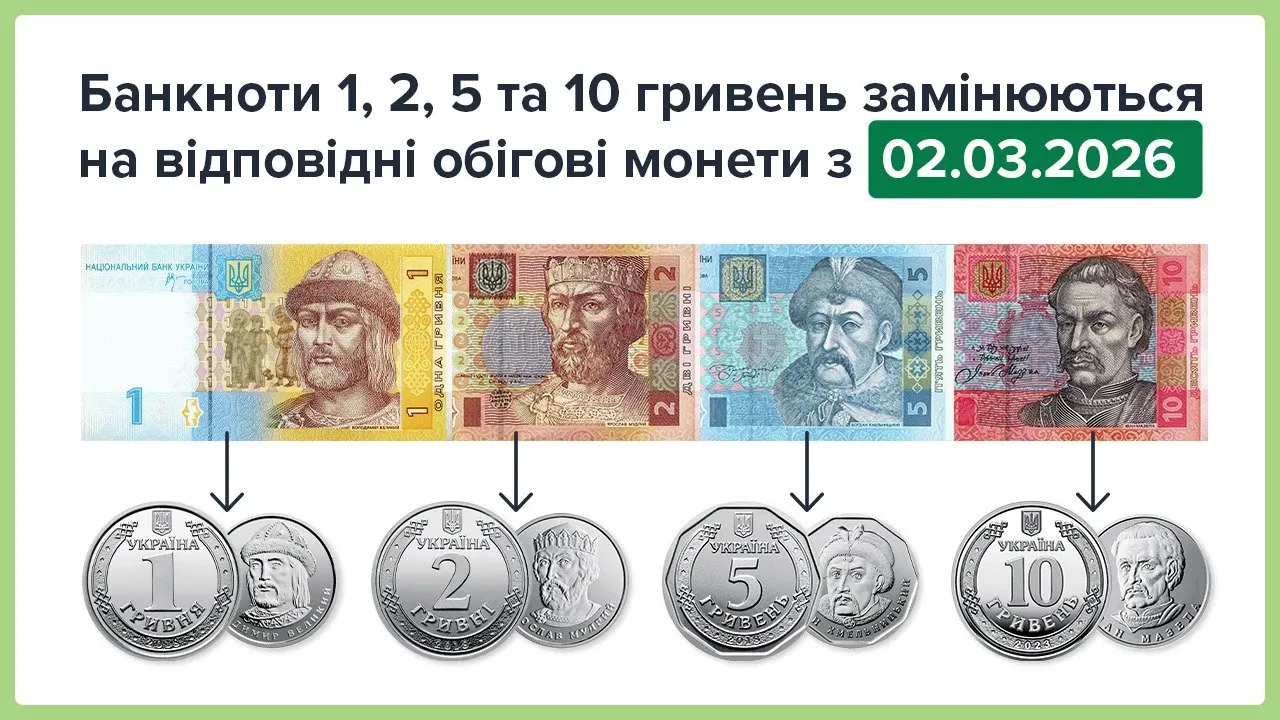
The National Bank of Ukraine has announced the complete withdrawal of 1, 2, 5, and 10 hryvnia banknotes from the 2003–2007 series. Starting from March 2, 2026, these banknotes will cease to be a means of payment in the country, and their place will be permanently taken by the corresponding coins that have long been in circulation.
This is reported by Finway
What Will Change for Citizens and Businesses
From the specified date, 1, 2, 5, and 10 hryvnia old series banknotes will no longer be accepted in retail networks, banks, financial institutions, and service establishments. All cash transactions in the aforementioned denominations will be conducted exclusively with coins. However, the withdrawal of paper hryvnias will occur gradually to ensure a smooth transition for the population and businesses.
“There are no restrictions on the amount of exchange, and no fees will be charged for such exchanges.”
Where and How to Exchange Withdrawn Banknotes
Citizens will be able to exchange withdrawn banknotes for coins or banknotes of other denominations in several ways:
- at all branches of banks in Ukraine until February 26, 2027, inclusive;
- at authorized banks (Oschadbank, PrivatBank, Raiffeisen Bank, PUMB) – for three years from the date of withdrawal, that is, until February 28, 2029, inclusive;
- at the central office of the National Bank of Ukraine – indefinitely.
During the exchange, there are no restrictions on the amount, and no commission is charged.
Reasons for Transitioning to Coins
According to the NBU, paper banknotes of small denominations are rarely used in retail trade. Their average lifespan is only 2.5 years, after which they quickly wear out and need replacement. In contrast, coins have a significantly longer lifespan – about 20–25 years.
The planned withdrawal of banknotes began earlier: for the 1 and 2 hryvnia denominations – from October 1, 2020, and for the 5 and 10 hryvnia denominations – from January 1, 2023. The transition to coins has already become commonplace for citizens and does not create additional difficulties, while also allowing the state and financial institutions to reduce costs related to printing, transporting, and storing banknotes, improve the quality of cash in circulation, and make transactions more convenient for all participants.