

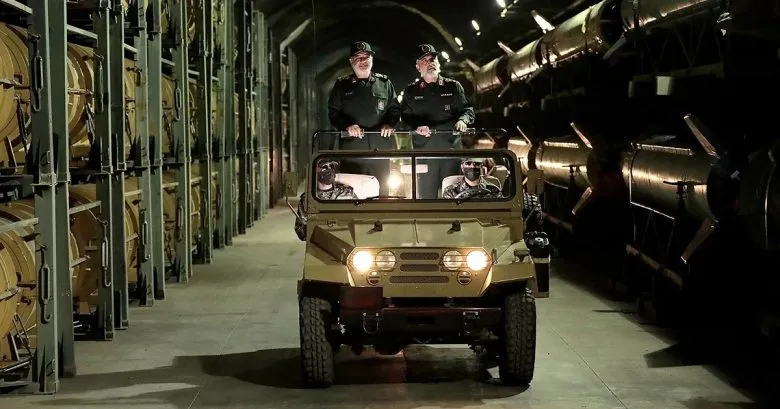
Recent intelligence data indicates that Iran is rapidly restoring its missile bunkers just hours after missile strikes from the US and Israeli forces. Despite active military operations, the country maintains significant missile and drone capabilities for strikes in the Middle East region.
This is reported by Finway
Strong Defense and Rapid Recovery
Iran has built entire “missile cities” in the mountains, where bunkers are located deep within rocky formations, capable of withstanding even strikes from the most powerful American bombs, such as the GBU-57 Massive Ordnance Penetrator. It is known that one of the key missile bases in Yazd is equipped with an automated rail system that connects tunnels with numerous exits and storage facilities. This structure allows for the rapid deployment of launchers to the surface for strikes and their immediate return to protected underground storage.
According to the latest report from American intelligence, even after numerous airstrikes, Iran is able to quickly repair its facilities, and the underground complexes remain operational. Launchers are extracted from the rubble and used for further attacks. Additionally, the country actively employs decoy targets, complicating the assessment of the actual scale of destruction for the US and its allies.
“It doesn’t matter how many combat sorties occur above it. The railways don’t care how many portals are sealed. Protection is provided by geology, and geological formations have existed for 300 million years.”
Change in Tactics and Assessment of Strike Effectiveness
Experts note that the decrease in the number of strikes from Iran may be a sign of tactical maneuvering: the country is improving the concealment of mobile launchers after their use. Despite official reports from the Pentagon about the destruction of 11,000 targets and three-quarters of Iranian launchers by early March, the Iranian Revolutionary Guard continues to conduct strikes in the region.
The number of missile launches has decreased from hundreds to less than 40 per day, while drone launches remain at 50–100 daily, most of which are intercepted. The US notes that multiple strikes on a single point and precise intelligence on the internal structure of the bunkers are necessary for the complete destruction of fortified underground facilities.
US Secretary of Defense Pete Hegseth emphasized that, despite the reduction in attacks, Iran is still capable of launching missiles, but American forces are prepared to intercept them and locate underground facilities. According to him, about half of Iran’s launchers remain intact, and some are temporarily inaccessible due to rubble; however, heavy machinery allows for quick restoration of access to them.
White House Press Secretary Anna Kelly noted that the number of Iranian attacks has decreased by approximately 90%, and Iran’s naval forces have been destroyed. Furthermore, she stated that two-thirds of Iran’s production capabilities have been damaged or destroyed, and the US and Israel have air superiority.
Previously, US President Donald Trump threatened massive strikes on Iran’s infrastructure, demanding the reopening of the Strait of Hormuz.