

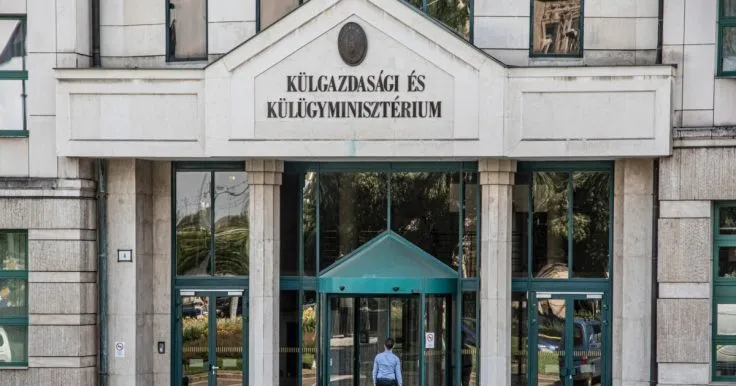
The Ministry of Foreign Affairs of Hungary summoned the Russian ambassador in Budapest in connection with the massive drone attack in Transcarpathia, where the Hungarian minority resides. The decision was made by Foreign Minister Anita Orbán, as reported at the first meeting of the new Hungarian government.
This is reported by Finway
Decisive response from the new Hungarian government
A meeting with the Russian ambassador is scheduled for the morning of May 14. Hungarian Prime Minister Péter Mádly emphasized that the government strongly condemns Russia’s attack on Transcarpathia. According to him, Anita Orbán will convey the official Budapest’s position during the conversation with the Russian ambassador and “request information on when Russia and Vladimir Putin plan to finally end this bloody war.”
The Ministry of Foreign Affairs of Hungary is in contact with the Hungarian consulate in Uzhhorod, and the government is ready to provide necessary assistance. This reaction marks a significant change compared to the policy of the previous government of Viktor Orbán, which did not respond to the summoning of the Russian ambassador regarding strikes on Ukraine.
Massive attack and Ukraine’s response
“An important message condemning the Russian attack against Ukraine from Hungarian Prime Minister Péter Mádly. Moscow has once again demonstrated that it poses a common threat not only to Ukraine but also to neighboring countries and Europe as a whole. The attack continues. The first missiles have been launched. Our united position is crucial for ending this brutal war. Thank you for your concern and strong stance,” he wrote in a telegram.
According to the head of the Transcarpathian OVA, Myroslav Biletsky, on May 13, during a massive strike by Russia, hits on critical infrastructure facilities were recorded in several districts of Transcarpathia. This was the most powerful shelling of the region since the beginning of Russia’s full-scale invasion. According to the regional administration, there are no casualties.
The Air Force of the Armed Forces of Ukraine reported that throughout the day, the enemy attacked Ukraine with 753 strike drones, and together with nighttime attacks, a total of 892 drones were launched. The main direction of the strike was the western regions. Defense was provided by aviation, anti-aircraft missile troops, electronic warfare units, and mobile fire groups. As of 6:30 PM, 710 enemy drones of the Shahed, Gerbera, Italmas types, and imitators of the Parody type were shot down or suppressed across the country. At the same time, 27 drone hits and debris falls were recorded at 26 locations.
President Volodymyr Zelensky noted that as a result of these attacks, six people were killed in various settlements.
The Main Intelligence Directorate reported the start of a combined prolonged airstrike by Russia on critical facilities in Ukraine, with a forecast for further use of a large number of cruise and ballistic missiles.
Reports of casualties and destruction following the attack on May 13 were received from Odesa, Khmelnytskyi, Rivne, Lviv, Transcarpathian, Ivano-Frankivsk, Volyn, Cherkasy, and Sumy regions. The Russian army regularly attacks Ukrainian cities and civilian infrastructure with various types of weapons – kamikaze drones, missiles, aerial bombs, and multiple launch rocket systems.
Ukrainian authorities and international organizations classify these strikes as war crimes of the Russian Federation, emphasizing their targeted nature. Systematic shelling of vital facilities and healthcare institutions aimed at depriving the population of electricity, heat, water, communication, and medical assistance exhibits signs of genocidal actions.
Legal experts and genocide researchers emphasize that during the full-scale war, Russia is committing a series of actions that may fall under the definition of genocide. This includes public calls for the destruction of Ukrainians, targeted strikes on life-support systems, persecution of pro-Ukrainian individuals in occupied territories, extermination of the intelligentsia, deportation of children, and destruction of Ukrainian cultural heritage.
The UN Convention on the Prevention and Punishment of the Crime of Genocide, adopted in 1948, obligates 149 participating countries to prevent and punish acts of genocide both in wartime and peacetime. Genocide is defined as actions intended to destroy, in whole or in part, a national, ethnic, racial, or religious group. Among the signs of genocide are intentional killing, causing serious bodily harm, creating conditions for the destruction of the group, obstructing childbirth, and forcibly transferring children.
Despite this, the Russian leadership denies intentional strikes on civilian infrastructure and the killing of peaceful residents of Ukraine during the war.