

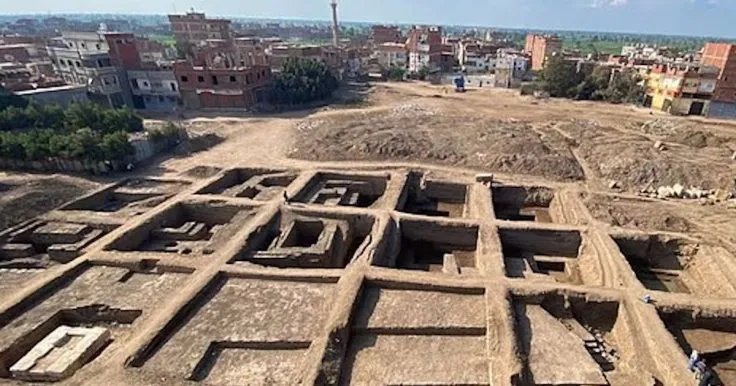
Archaeologists have reported a sensational discovery — in the area of Tel-Faraun, located in the eastern Nile delta near the Red Sea, a fragment of a massive statue, likely depicting Pharaoh Ramses II, has been found. Many historians associate him with the pharaoh mentioned in the biblical story of Moses and the events of the Exodus.
This is reported by Finway
Discovery of Ancient Sculpture in the Nile Delta
According to archaeological data, the found fragment consists of the base and legs of the statue. Its height reaches about two meters, and its weight is estimated at 5–6 tons. Researchers emphasize that although some elements of the statue are noticeably worn and damaged, the preserved details allow it to be identified as part of a royal sculpture from the New Kingdom period of Egypt (1550–1070 BC).
Preliminary analysis suggests that this statue may not have originally been created for the location where it was discovered. Archaeologists hypothesize that the sculpture may have been transported from the city of Pi-Ramses — once a major royal center founded by Ramses II. Later, the statue was likely reused in the temple complex of the city of Emet (modern-day Tel-Faraun).
“It should be noted that part of a large statue was discovered in Tel-Faraun in the eastern part of the Nile delta, northwest of the Red Sea. The discovery was made during excavations conducted by the Supreme Council of Antiquities, and consists of the legs and base.”
Historical Context and Significance of the Find
Ramses II, who ruled from 1279 to 1213 BC, is considered one of the most outstanding pharaohs of Ancient Egypt. He was celebrated as a talented military leader who commanded an army of about 100,000 warriors. Researchers have repeatedly identified him with the biblical pharaoh whom, according to the Book of Exodus, Moses confronted when demanding the release of the Israelites from slavery. The basis for this version is the mention in Exodus 1:11 of the construction of the city of Raamses (Pi-Ramses) by Hebrew slaves, although the Bible does not specify the name of the pharaoh himself.
Experts suggest that the found statue may have been part of a large sculptural composition depicting the king alongside Egyptian gods. Such triads are often found in the monumental temple art of that period. Further analysis of the stone, carving techniques, and surface will help understand how this massive statue was transported across the Nile delta.

It is believed that the fragment depicts Ramses II, one of the most powerful rulers of Ancient Egypt.
Currently, archaeologists continue to conduct thorough studies of the found artifact, hoping to gain new insights into the history of monumental art and the movement of sculptures during the reign of Ramses II.