

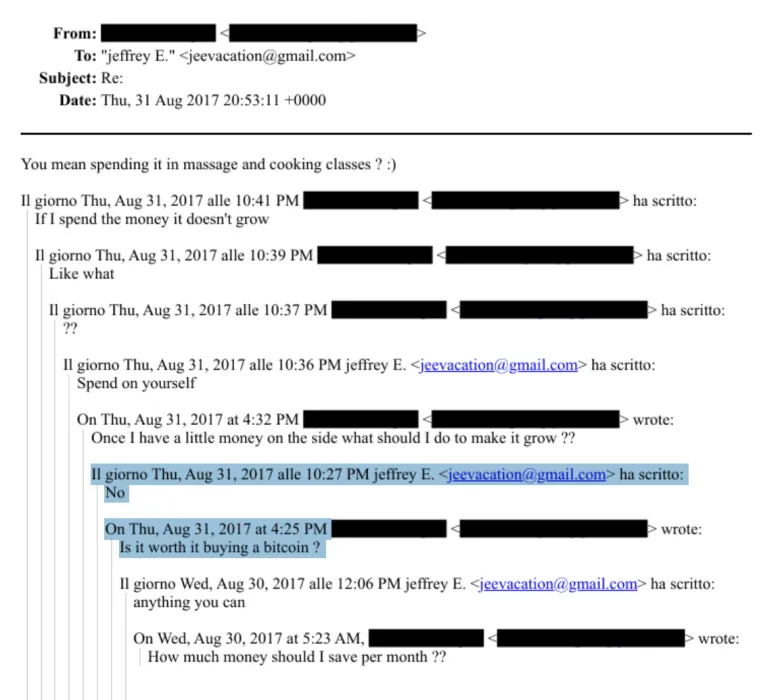
A fresh batch of declassified materials in the Jeffrey Epstein case has revealed his significant interest in Bitcoin, digital assets, and related investment opportunities. The documents include correspondence discussing cryptocurrency matters with venture business representatives, as well as mentioning key industry players and major technology companies.
This is reported by Finway
Epstein’s Involvement in Cryptocurrency Investments
According to the materials, Jeffrey Epstein was familiar with Bitcoin as early as 2011 and invested in both BTC and crypto startups. His correspondence includes discussions with PayPal co-founder Peter Thiel regarding the first cryptocurrency. According to CryptoQuant founder Ki Young Ju, Epstein was primarily interested in the profitability of such investments rather than the ideology of Bitcoin. He preferred short-term trading and was skeptical that BTC would become mainstream.
“Jeffrey Epstein knew about Bitcoin back in 2011 and invested in BTC and crypto startups, although he was more interested in profit than philosophy. He was skeptical that Bitcoin would ever become mainstream, so he traded it rather than holding it for the long term.”
In addition to direct investments, Epstein considered ideas for creating new digital assets for various regions. For instance, in a letter to Saudi officials in 2016, he proposed a concept of two currencies for the Middle East, one of which was to comply with Sharia law and be modeled after Bitcoin.
Interaction with Michael Saylor and Blockstream
The declassified materials repeatedly mention the name of prominent Bitcoin supporter and co-founder of Strategy (formerly MicroStrategy) Michael Saylor. One letter, dated 2010, describes his donation of $25,000 to an event related to Epstein’s circle, which granted him access to elite gatherings.
According to the correspondence, Saylor was characterized as someone with difficulties in social interactions and was even referred to as a “creepy guy.” However, there is no evidence of any illegal behavior on his part, although the mere mention of his name drew attention to Epstein’s connections in the technology and finance sectors.
A separate section of the documents pertains to Blockstream and its leadership. In the letters, Blockstream co-founder Austin Hill discussed supporting crypto projects with Epstein and criticized platforms like Stellar and Ripple, considering them harmful to the Blockstream ecosystem.
Joint trips to Saint Thomas Island are also mentioned, where both Austin Hill and Blockstream CEO Adam Back were present. The latter publicly stated that the company had no financial or other ties to Epstein or his heirs. According to Back, the acquaintance with the financier occurred through Joi Ito’s fund in 2014, which later sold a minority stake in Blockstream due to the risk of a conflict of interest. Back emphasized that the mention of names in the documents does not imply involvement in illegal activities.
Despite these explanations, parts of the public continue to criticize the past contacts of Blockstream’s leadership with Epstein, noting the company’s insufficiently prompt response to the information that has come to light.
Analysts continue to examine the documents published by the U.S. Department of Justice, which also mention notable figures such as Elon Musk, U.S. President Donald Trump, Microsoft co-founder Bill Gates, U.S. Secretary of Commerce Howard Lutnick, and other representatives from politics, finance, and the technology industry.