


In the past, Earth was home to insects of impressive sizes, including griffins — ancient relatives of modern dragonflies with wingspans of up to 70 centimeters. For a long time, scientists believed that the primary reason for the reduction in insect sizes was the decreased level of oxygen in the atmosphere. However, new research calls this hypothesis into question.
This is reported by Finway
From Giant Griffins to Modern Dragonflies
About 300 million years ago, insects significantly larger than their modern counterparts inhabited the Earth. Griffins — extinct relatives of dragonflies — were remarkable not only for their size but also for their ability to fly despite their considerable body mass. Scientists long explained this by stating that at that time, the oxygen level in the atmosphere was approximately 45% higher than it is today. This allowed insects, which do not have lungs and breathe through a system of tracheae, to supply large volumes of oxygen to their massive bodies.
It was believed that the decrease in oxygen content made the existence of such giants impossible, leading to evolution towards smaller sizes. Anatomically larger bodies require more oxygen; however, the surface area through which it is absorbed does not increase as quickly as the volume of the body. Therefore, upon reaching a critical size, an insect cannot obtain enough oxygen to sustain its life. Nevertheless, new studies compel a reevaluation of this concept.
Modern Research and Reevaluation of Hypotheses
A group of scientists studied the tracheae of 44 insect species from ten orders, among which the largest weighed up to 10,000 times more than the smallest. It turned out that tracheae occupy only 0.47% to 0.83% of the muscle tissue, regardless of the size of the insects. Even in giant fossil insects, such as Meganeuropsis permiana, weighing about 100 grams, the proportion of tracheae was only about 1% of the muscles.
“For more than half of the time since the emergence of insects, the size of the largest representatives in the fossil record approximately corresponded to the oxygen content. However, around 135 million years ago, this connection was disrupted — the atmosphere in the Cretaceous period was not as rich in oxygen as in the Carboniferous, but its level was higher than today and much higher than in the Jurassic period. Unfortunately, flying insects could not fully regain their former sizes, which, according to the authors of the new study, is likely explained by the emergence of competition from flying insects and predators — birds and pterosaurs.”
The researchers concluded that the reduction in insect sizes cannot be explained solely by oxygen limitations. Anatomical structures would allow them to adapt to lower oxygen levels by increasing the number of tracheae. The emergence of new competitors and predators, including birds and pterosaurs, as well as changes in the exoskeleton of modern insects, likely became the main factors limiting their further growth.
Changes in the atmosphere, as well as biological and ecological factors such as competition and the evolution of the exoskeleton, play a significant role in determining the sizes of modern insects. The study, published in the journal Nature, opens new avenues for exploring the evolutionary processes of ancient life on our planet.
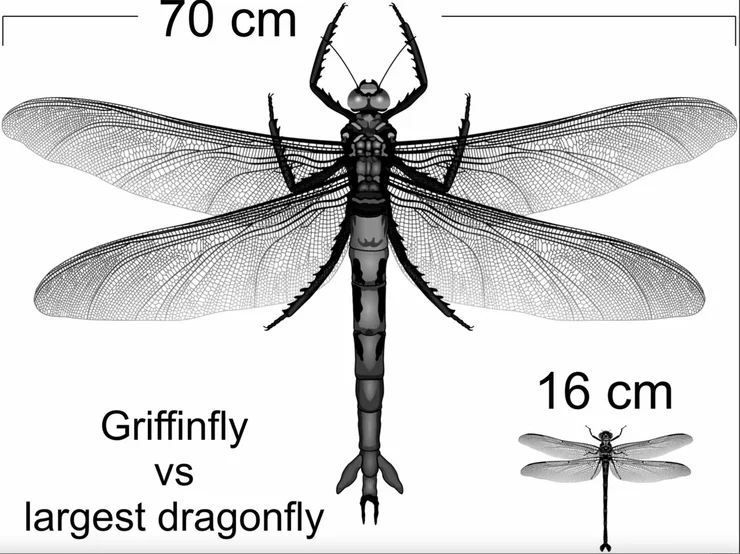
- Griffins — ancient relatives of dragonflies that had wingspans of up to 70 cm, lived on Earth about 300 million years ago.
- Changes in insect sizes are more related to competition and the evolution of predators than solely to the oxygen level in the atmosphere.
- The structural features of the exoskeleton of modern insects may also influence their maximum sizes.