

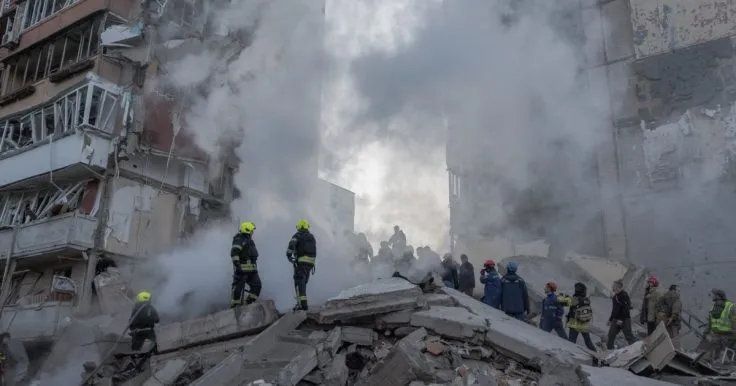
On the night of May 14, the Russian army carried out one of the largest air attacks on Ukraine, using a wide arsenal of weapons: strike drones and various types of missiles. The main target of the Russian strike was Kyiv, but other regions of the country were also attacked.
This is reported by Finway
Scale of the Attack and Air Defense Operations
According to the Air Force Command, radio-technical troops detected and tracked 731 aerial targets. Among them:
- three air-launched ballistic missiles X-47 “Kinzhal” fired from the Lipetsk region of Russia;
- 18 ballistic missiles “Iskander-M/S-400” from the Bryansk and Kursk areas;
- 35 cruise missiles X-101 from the Vologda region;
- 675 strike drones of various types launched from the Bryansk, Kursk, Oryol, Millerovo, Primorsko-Akhtarsk directions, as well as from the occupied Crimean regions of Hvardeyske and Chervonohryhorivka.
By 8 a.m., air defense forces had destroyed 693 aerial targets, including 29 cruise missiles X-101, 12 ballistic missiles “Iskander-M/S-400,” and 652 drones of various types. Despite the effective work of the defense, 15 missiles and 23 strike UAVs were recorded hitting 24 locations, as well as debris from downed drones falling on 18 objects.
“15 missiles and 23 strike UAVs were recorded hitting 24 locations, as well as debris from downed UAVs falling on 18 locations.”
Consequences of the Shelling and Qualification of Russia’s Actions
As a result of another Russian attack in Kyiv, one civilian was killed, and dozens were reported injured: the State Emergency Service reported 31 injured, while the Kyiv City Military Administration reported 29 individuals. Residential buildings and infrastructure facilities were damaged.
Russia continues to carry out massive strikes on Ukrainian cities using various types of weapons – from missiles to guided bombs, multiple launch rocket systems, and kamikaze drones. Such attacks are aimed at destroying critical infrastructure, hospitals, water and energy supply systems, which is indicative of criminal actions against the civilian population. Ukrainian authorities and international organizations classify these strikes as war crimes of the Russian Federation, emphasizing their targeted nature.
Lawyers and genocide researchers note that during the full-scale war, Russia is committing all types of crimes that may fall under the definition of genocide. Among the signs: the destruction of Ukrainians as a national group, targeted shelling of infrastructure, persecution in occupied territories, deportation of children, public calls for the destruction of Ukrainians, and depriving the population of basic living conditions.
According to the UN Convention on the Prevention and Punishment of the Crime of Genocide, adopted in 1948, genocide is defined as acts committed with the intent to destroy, in whole or in part, a national, ethnic, racial, or religious group. The Convention emphasizes the obligation of participating countries (currently 149) to prevent acts of genocide and hold those responsible accountable.
At the same time, the leadership of Russia continues to deny involvement in targeted strikes on the civilian infrastructure of Ukrainian cities and villages, despite numerous evidence of the destruction of peaceful civilians, hospitals, schools, and life-supporting facilities.