

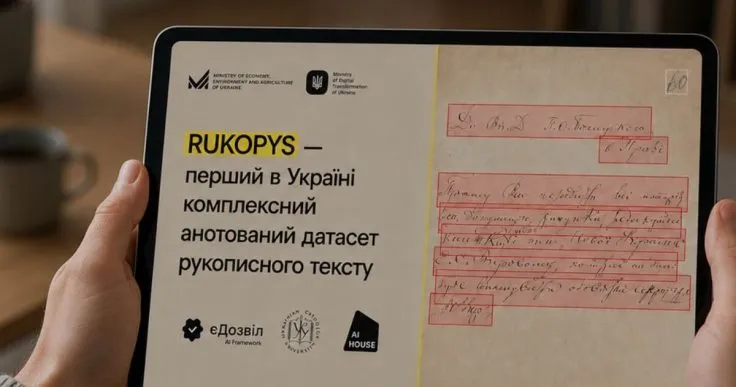
The first large-scale open dataset of handwritten text — RUKOPYS — has been officially presented in Ukraine. Its creation is an important step for the development of automatic handwritten document recognition technologies in both the public and private sectors of Ukraine.
This is reported by Finway
“RUKOPYS is the first systematic Ukrainian dataset containing structured samples of handwritten text in various styles”.
Uniqueness and Significance of the New Dataset
This initiative was implemented in partnership with the Ministry of Economy, Environment and Agriculture of Ukraine, the Ministry of Digital Transformation, AI HOUSE, and the Ukrainian Catholic University. The lack of localized data has significantly hindered the creation of Ukrainian models for handwritten text recognition. Now RUKOPYS is set to fill this critical gap, allowing developers to train artificial intelligence systems based on real Ukrainian documents.
Practical Use of RUKOPYS and Digital Transformation
Alongside the launch of the dataset, a special initiative for developers — a hackathon — will commence, during which teams will create tools for the automatic conversion of handwritten documents into electronic format. The main focus is on real application scenarios: processing applications, certificates, archival materials, and internal documentation in government institutions.
It is expected that the implementation of RUKOPYS will significantly reduce the volume of manual work with documents and alleviate the workload on civil servants. This will also contribute to speeding up data processing and become an important component of the transition to fully automated document circulation in government bodies.
It is worth noting that the Ministry of Digital Transformation of Ukraine continues to actively work on the development of artificial intelligence directions. In particular, a strategic meeting was held with representatives of Google regarding the creation of a new AI infrastructure for government services. One of the key projects is the preparation for the large-scale implementation of “Diia.AI” — a digital assistant based on artificial intelligence, which is planned to be integrated into the “Diia” application.