

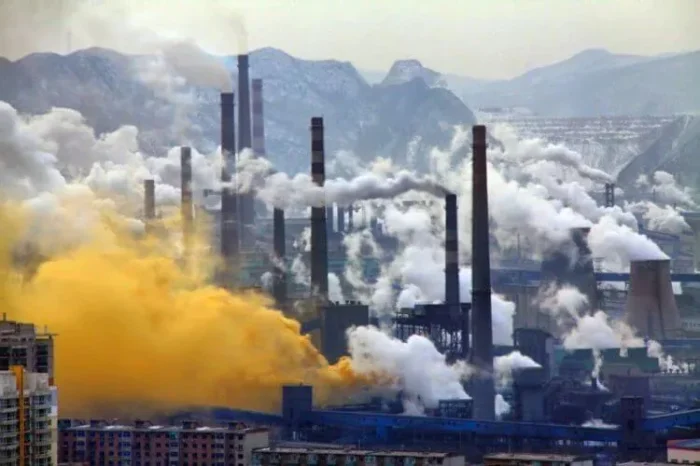
The extractive industry remains the leader among sectors in Ukraine in terms of negative environmental impact. This sector accounts for 49% of all carbon dioxide (CO2) emissions and 54% of the total volume of other pollutants, excluding CO2.
This is reported by Finway
Main Pollutants and Impact Scale
These results were presented by co-founder of ESG SaveEcoBot Pavlo Tkachenko during the presentation of an analytical study covering the period from 2020 to 2024, conducted by the NGOs SaveDnipro and SaveEcoBot. The report particularly focused on companies that are part of the Extractive Industries Transparency Initiative (EITI), which is an independent international standard for transparency and includes over 50 countries worldwide.
According to Tkachenko, more than half of the harmful emissions in Ukraine come from EITI companies. The analysis for 2024 showed that extractive companies under this initiative account for 54% of pollutant emissions excluding CO2 and 49% of carbon dioxide emissions.
“Analyzing the data for 2024, we found that the share of EITI in the extractive sector’s emissions of pollutants excluding carbon dioxide is 54%, while for CO2 emissions it is 49%. This means that almost every second ton of carbon dioxide comes from extractive enterprises,” Tkachenko detailed.
Waste and Water Resources
In addition to its impact on air quality, the extractive industry generates 93% of all industrial waste in the country. EITI companies also account for 51% of all discharges of wastewater into surface water bodies, significantly affecting the state of water resources.
The study presents a ranking of leading companies based on their emissions. Among them, the leaders in total pollutant emissions (excluding CO2) are: JSC “DTEK Zakhidenergo” (over 138,000 tons), PJSC “DTEK Pavlogradvugillia” (almost 133,000 tons), PJSC “ArcelorMittal Kryvyi Rih” (over 65,500 tons), PJSC “Tsentrenergo” (almost 30,000 tons), and SE “Lvivvuhillia” (approximately 23,500 tons).
Regarding annual CO2 emissions, the leaders are: JSC “DTEK Zakhidenergo” (more than 7 million tons), PJSC “ArcelorMittal Kryvyi Rih” (over 5 million tons), KP “Kyivteploenergo” (3.5 million tons), PJSC “Tsentrenergo” (2.6 million tons), and PJSC “Ivano-Frankivskcement” (2.5 million tons).
Experts note that this ranking is not a legal assessment but reflects statistical data demonstrating that the lion’s share of negative environmental impact is generated by a relatively small number of large enterprises. This, according to specialists, allows the state and the public to focus on the most problematic facilities and promote the implementation of modern technologies to minimize harm.
Tkachenko emphasized the importance of a deeper analysis of the permits granted to such enterprises and highlighted that systematic ranking enables the state to set priorities for investments and measures aimed at reducing the negative impact of the extractive sector on the environment.