

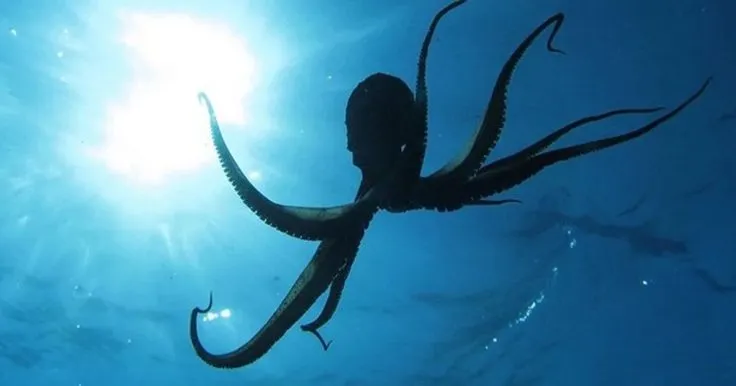
A group of researchers from Hokkaido University has found evidence of the existence of enormous octopuses that inhabited the ocean approximately 72–100 million years ago. The new study suggests that these ancient invertebrates reached lengths of up to 19 meters, comparable to modern sperm whales.
This is reported by Finway
Giants of the Cretaceous Ocean
Oceans have always been home to extraordinary creatures, some of which have long since disappeared. Scientists, re-examining 15 fossilized jaws of ancient relatives of octopuses, identified two new species. One of them, Nanaimoteuthis haggarti, exhibited significant wear on its jaws. This indicates that it was an active predator capable of crushing hard shells and bones with powerful bites.
According to the researchers, these giants developed a soft body that provided them with extraordinary mobility, sharp vision, and high intelligence. Their long and flexible tentacles allowed them to capture large prey and manipulate it with their beaks.
“The earliest octopuses already had developed intelligence.”
Octopuses as Predators Shaping Marine Ecosystems
Researchers established that Nanaimoteuthis haggarti could reach lengths of up to 19 meters, competing in size with modern sperm whales. In comparison, the average height of a human is about 1.7 meters, while the largest elephants reach 3 meters. Octopuses were surpassed only by blue whales, whose lengths can exceed 27 meters.
The other discovered species, Nanaimoteuthis jeletzkyi, was smaller—up to 8 meters long—but was also a predator. Scientists emphasize that these ancient octopuses were not just part of the food chain but actively influenced the structure of marine ecosystems, performing roles previously attributed only to large vertebrates, such as sharks.
The structural features of the jaws of these creatures, particularly the asymmetry of the edges, indicate the presence of a dominant side for chewing—a sign of complex cognitive abilities and a developed brain.
This discovery not only confirms the existence of giant octopuses in ancient times but also expands our understanding of the diversity and complexity of marine life during the late Cretaceous period.