

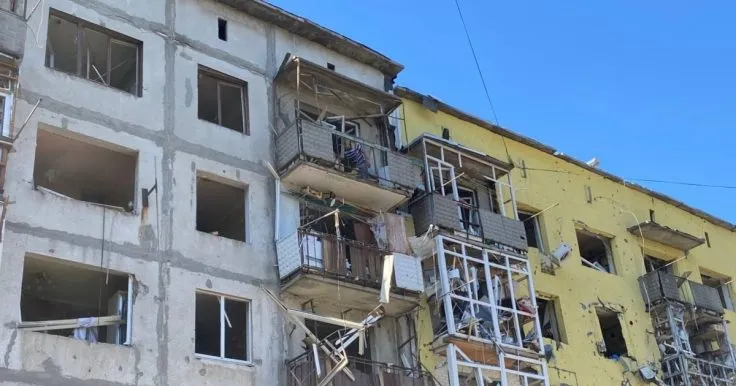
In the city of Druzhkivka in the Donetsk region, the Russian army carried out an airstrike, dropping three guided bombs “FAB-250” on residential areas. As a result of the attack, which occurred on June 1, five apartment buildings were damaged, reports the regional prosecutor’s office.
This is reported by Finway
Injured and Nature of Injuries
As a result of the shelling, five local residents aged between 20 and 68 were injured. Among the injuries diagnosed by doctors are blast injuries, shrapnel wounds, contusions, and concussions.
“As a result of the shelling, five civilians aged between 20 and 68 sustained bodily injuries. Four men and a woman were diagnosed with blast injuries, shrapnel wounds, contusions, and concussions.”
Law enforcement agencies have already opened a criminal case regarding the war crime, emphasizing that strikes on civilian objects are a direct violation of international humanitarian law.
Russian Shelling as a Sign of War Crimes
Russian military forces systematically use various types of weapons — strike drones, missiles, guided bombs, and multiple launch rocket systems — to attack Ukrainian cities and civilian infrastructure across the country. Ukrainian authorities, along with international organizations, classify such actions as war crimes of the Russian Federation, emphasizing their targeted nature.
The destruction of life-support systems, healthcare facilities, and social infrastructure aimed at depriving people of electricity, heat, water, communication, and medical assistance is considered a manifestation of genocidal actions. Legal experts and genocide researchers note that Russia, during the large-scale war, resorts to all kinds of crimes that may fall under the definition of genocide. Such actions include: public calls for the destruction of Ukrainians, shelling of civilian objects, persecution of individuals with pro-Ukrainian positions, destruction of the intelligentsia, deportation of children, and destruction of cultural heritage.
The Convention on the Prevention and Punishment of the Crime of Genocide, adopted by the UN General Assembly in 1948, obliges 149 participating states to prevent genocide and punish those guilty of committing it both during wartime and in peacetime. The document defines genocide as actions aimed at the complete or partial destruction of a national, ethnic, racial, or religious group, including through killings, causing serious bodily harm, creating unbearable living conditions, preventing childbirth, and forcibly transferring children.
Despite numerous evidence and international investigations, the leadership of Russia denies targeted strikes on civilian infrastructure and the deaths of peaceful residents of Ukraine.