

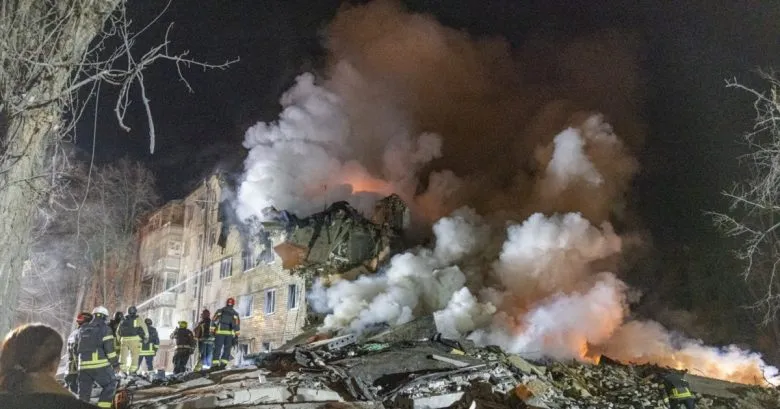
On the night of March 7, the Russian Federation launched a massive combined strike on Ukraine’s critical infrastructure, employing a wide arsenal of drones and missiles. According to the Air Force Command, this time the Russian army used a total of 509 air attack means.
This is reported by Finway
Scale of the Attack and Directions of Strikes
In total, Ukrainian radio engineering troops recorded the launch of two hypersonic ‘Zircon’ missiles from occupied Crimea, 13 ballistic ‘Iskander-M’/S-400 missiles from the territories of Bryansk, Kursk, and Voronezh regions, 14 cruise ‘Kalibr’ missiles from the Black Sea, as well as 480 strike drones of various types (‘Shahed’, ‘Gerbera’, ‘Italmas’, etc.), launched from several Russian regions and occupied areas of Crimea.
The main directions of the strike were Kyiv, Kharkiv, Zhytomyr region, Khmelnytskyi region, and Chernivtsi region. The military specifies that the attack was primarily aimed at important infrastructure facilities.
Results of Air Defense and Consequences of the Strikes
By 9 a.m., Ukrainian air defense units had destroyed or suppressed 472 targets: 453 strike drones and 19 missiles, including eight ballistic missiles of the ‘Iskander-M’/S-400 series and 11 cruise ‘Kalibr’ missiles.
“The Air Forces recorded hits from nine missiles and 26 strike UAVs at 22 locations, as well as debris from drones falling in five places. Information regarding one Russian missile is being clarified.”
According to preliminary data, in Kharkiv, as a result of a missile hitting a residential building, seven people were killed, with casualties and injuries also reported in Kharkiv region and Dnipropetrovsk region.
Russian troops systematically carry out attacks on Ukrainian cities, using various types of weapons, including strike UAVs, missiles, aerial bombs, and multiple launch rocket systems. The shelling is primarily aimed at civilian infrastructure across all regions of the country.
Ukrainian authorities and international organizations classify such strikes as war crimes of the Russian Federation, emphasizing their targeted nature. Particular concern is raised by attacks on the life-support systems of the population and medical facilities, depriving people of electricity, heat, water supply, communication, and other critically important assistance.
Human rights defenders, genocide researchers, and lawyers point to signs of genocidal actions in the actions of the Russian Federation, such as public calls for the destruction of Ukrainians, shelling of civilian infrastructure to deprive the population of basic living conditions, persecution of pro-Ukrainian citizens in occupied territories, destruction of the intelligentsia, deportation of children, and destruction of national cultural heritage.
The Convention on the Prevention and Punishment of the Crime of Genocide, adopted by the UN General Assembly in 1948, obliges participants (149 as of March 2026) to prevent genocide and punish such actions in both wartime and peacetime.
According to the Convention, genocide is defined as actions aimed at the total or partial destruction of a national, ethnic, racial, or religious group, including killings, causing serious bodily or mental harm, creating conditions for destruction, preventing births within the group, and forcibly transferring children to another group, as well as publicly inciting such actions.
The leadership of Russia continues to deny targeted attacks on Ukraine’s civilian infrastructure, despite numerous facts of destruction of hospitals, schools, energy facilities, water supply systems, residential buildings, and casualties among the civilian population.