

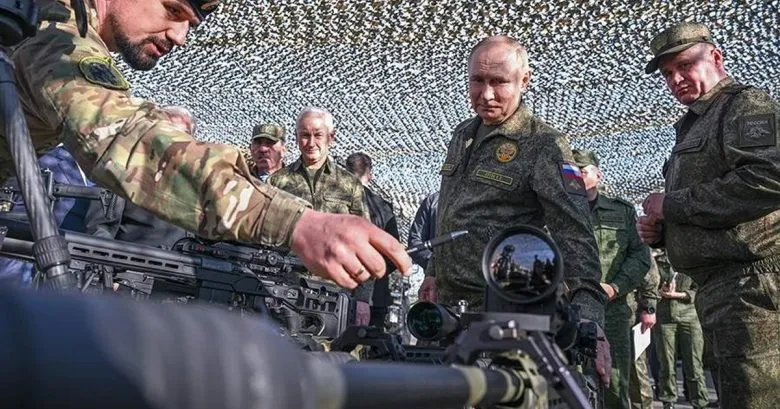
Former U.S. intelligence officer Eugene Rumer, who currently works at the Carnegie Endowment, has expressed concerns about possible actions by Vladimir Putin regarding NATO countries. In his view, the Kremlin leader, feeling pressure and isolation due to failures in Ukraine, may consider a scenario of limited military aggression against Europe in order to achieve at least some success on the battlefield.
This is reported by Finway
The Crisis in the Kremlin and Risks to European Security
In his report “Militant and Besieged: Russia After the War with Ukraine,” released back in March, Rumer emphasizes the difficult situation Putin found himself in during the spring of 2026. The Russian army is suffering significant losses on the front lines without making substantial breakthroughs, and Putin himself is unable to effectively support his allies, including Iran. Meanwhile, Hungary has undergone a political change — Peter Magyar has become Prime Minister instead of Viktor Orban, further weakening Russia’s position in Europe.
Rumer highlights that the current moment could represent a “window of opportunity” for the Kremlin, as European countries have not yet completed their rearmament, and Ukraine is only developing modern weaponry capable of striking targets deep within Russia. At the same time, U.S. President Donald Trump is demonstrating an ambiguous stance on NATO, which could undermine transatlantic unity.
The Threat of Attack and the West’s Response
In his warnings, Rumer notes that Russia, having exited the war against Ukraine, could become even more dangerous and aggressive towards Europe. He emphasizes:
“Having invaded Ukraine under the false pretext of securing its western flank, Russia is poised to emerge from the war less secure, more embittered, and more dangerous to Europe than before the war. The perception of it as a threat will cast a long shadow over Europe.”
Michael Kofman, a leading military analyst at the Carnegie Endowment, points out that in 2026, Russian forces suffered heavy losses, and the dynamics of the fighting this year do not give Putin reason to expect quick victories. Estimates suggest that in March alone, Russia lost between 30,000 and 35,000 killed and wounded, and these losses are difficult to compensate. Experts indicate that Ukraine remains an “unfinished business” for Putin, while Europe is a key theater for potential future actions.
According to Rumer, the Kremlin is convinced that Europe is effectively at war with Russia, and Russia itself is already waging a “hybrid” war against Ukraine’s allies, employing sabotage and threats. NATO Secretary General Mark Rutte warned last year that Russia might be prepared to resort to military force against the alliance within the next five years.
Recently, pressure from Russia on European countries has increased: the Russian Ministry of Defense openly threatened strikes against those countries supplying drones to Ukraine — specifically Germany, the United Kingdom, Sweden, Italy, and the Netherlands. Additionally, former Russian President Dmitry Medvedev continues to publish aggressive statements regarding the EU and NATO.
Rumer considers the worst-case scenario in which Putin might launch an attack on one of the Baltic neighbors to demonstrate the weakness of NATO’s Article 5 and test the alliance’s readiness to defend its members. He emphasizes that if Trump does not defend allies, this opens additional risks for European security.
Since 2023, European intelligence agencies have warned of the potential threat of a Russian attack on EU and NATO countries, although at that time it was predicted that this could happen in 2025. Today, amid the protracted war in Ukraine and new geopolitical challenges, the risks of further escalation remain high.