

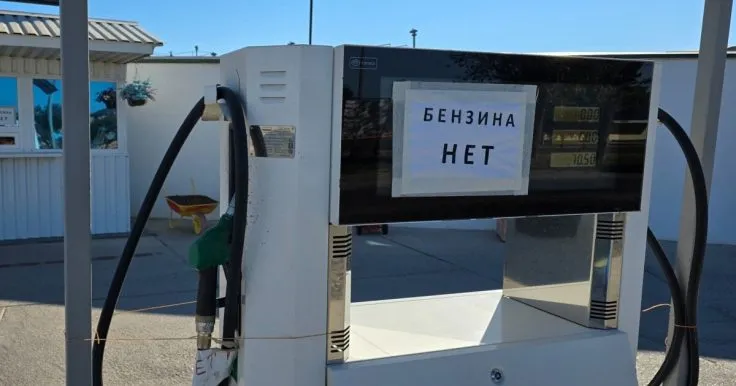
The occupying administration of the so-called “LPR”, which controls part of the Luhansk region under Russian authority, has announced the introduction of a limit on gasoline sales. According to their information, the restrictions are related to the increase in demand for fuel, which is why gas stations in the region will now sell no more than 20 liters of gasoline per person.
This is reported by Finway
Temporary fuel limit and the situation in Crimea
A statement released on June 2 by the “LPR government” emphasizes the temporary nature of these restrictions — they plan to lift them after the situation with fuel supply stabilizes.
“The restrictions are temporary and will be lifted after the situation with fuel supplies improves.”
At the end of May, similar measures were implemented in the occupied territories of Crimea and Sevastopol: there, due to a severe fuel shortage, gasoline sales have been introduced via coupons. Since May 31, AI-95 gasoline in the ATAN and TES networks on the peninsula is sold only by coupons, while the sale of AI-92 is limited to 20 liters per vehicle. In Sevastopol, both grades of gasoline are currently sold exclusively by coupons. The occupying head of Crimea, Sergey Aksyonov, stated that the situation is expected to stabilize within a month, while the Russian governor of Sevastopol, Mikhail Razvozhayev, emphasized the temporary nature of the restrictions, highlighting their necessity for replenishing fuel supplies.
Causes of fuel shortage in occupied territories
Problems with the supply of gasoline and diesel fuel to the occupied parts of Ukraine have arisen against the backdrop of intensified strikes by the Armed Forces of Ukraine on logistical routes between Crimea and Russia. Recently, the Ukrainian army has significantly increased the number of missile and drone attacks on the routes that are key for supplying Russian troops in the occupied regions. The Armed Forces of Ukraine are also actively striking at Russia’s fuel and oil infrastructure deep in the rear, further complicating the supply of fuel to the occupied territories.
According to experts, these actions have become one of the main reasons for the fuel shortage in the region, forcing the occupying administrations to implement restrictions on its sale.