

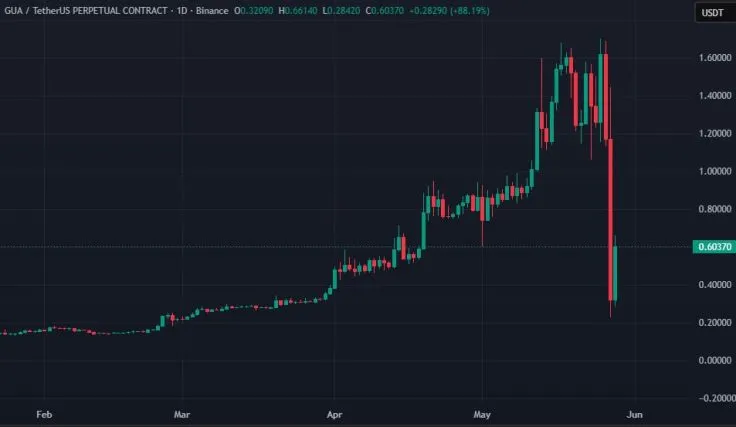
The GUA token has become the center of a security incident that led to its sharp devaluation in the cryptocurrency market. The SUPERFORTUNE AI team reported an investigation into the situation that occurred on May 27, 2026, resulting in approximately an 85% drop in the asset’s price.
This is reported by Finway
Details of the Incident and Attack Theories
According to SUPERFORTUNE AI, the incident was related to the manipulation of a multisig transaction during the unlocking of additional tokens for an airdrop. During the operation, funds were sent not to the target address but to a third-party address, which the team identified as the address of a potential attacker. Preliminary analysis showed that this address had no prior connections to the project’s wallets, and therefore the team does not consider address poisoning to be the most likely cause of the event.
SUPERFORTUNE AI emphasized that their internal operational procedures include several stages of verification and reconciliation of addresses to minimize the risks of such incidents.
“The SUPERFORTUNE AI team reported an investigation into the security incident that affected the GUA token on May 27, 2026. According to the project, the event caused significant volatility in the asset.”
Market Reaction and Next Steps
As a result of the incident, the price of the GUA token sharply fell from approximately $1.7 to $0.23. After that, the asset partially recovered, and its current value is around $0.6. Significant volatility is observed on the GUA/USDT.P chart on the Binance exchange during this period.

Users on platform X (formerly Twitter) actively commented on the event, urging the SUPERFORTUNE AI team to restore the token’s price to previous levels. Meanwhile, the project continues its investigation: the team has already contacted law enforcement and engaged incident response specialists.
For reference, address poisoning is a type of crypto fraud where attackers create a wallet address that is nearly identical to a legitimate one and send a small transaction from it. This address ends up in the user’s transaction history, and in the future, they may mistakenly copy it, sending funds to the fraudsters instead of the actual recipient.
Earlier, in March 2026, the Trust Wallet crypto wallet had already implemented additional protection against address substitution fraud to enhance user security.