

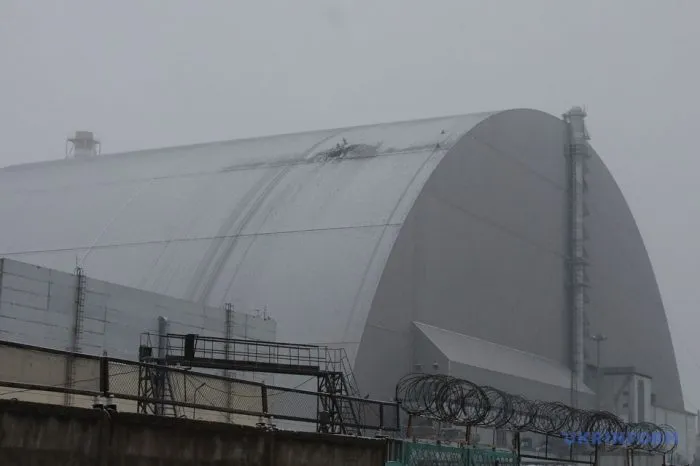
The condition of the protective sarcophagus over the fourth reactor of the Chernobyl Nuclear Power Plant raises serious concerns among international experts and environmental organizations. According to “Greenpeace Ukraine,” following a Russian drone attack in February 2025, the structure of the New Safe Confinement (NSC) was damaged, significantly complicating the planned dismantling of the sarcophagus. The risk of its collapse is rapidly increasing.
This is reported by Finway
Threat of International Scale
According to the report from “Greenpeace Ukraine,” Russia’s war against Ukraine poses a direct threat to global efforts to mitigate the consequences of the Chernobyl disaster. The document states that the ruins of reactor No. 4 and the sarcophagus located within the NSC cannot currently be dismantled due to the damage caused by the drone attack. Without urgent repairs to the confinement structure, the likelihood of an emergency situation sharply increases.
“The damage was caused by a Russian drone attack in February 2025. Inside the NSC are the ruins of reactor No. 4 and the sarcophagus. The sarcophagus needs to be dismantled as soon as possible, but due to the damage to the NSC, this is currently impossible,” the report states.
Experts’ Position and International Community Response
Engineer Eric Schmieman, who participated in the design and construction of the NSC, emphasizes that without immediate restoration work, there is a real threat of the old sarcophagus collapsing. Senior nuclear specialist at “Greenpeace Ukraine,” Sean Bernie, also highlights the heightened danger: the drone strike increased the risk of the sarcophagus collapsing even before a safe dismantling can be ensured.
Furthermore, experts are calling for maximum sanctions against the Russian corporation “Rosatom,” which illegally controls the Zaporizhzhia Nuclear Power Plant. At the same time, “Greenpeace Ukraine” notes that efforts to impose strict international restrictions on “Rosatom” are being blocked by certain countries, including Hungary and France, while financial flows from contracts with this company continue to fund the war against Ukraine.
A key issue for Ukraine and its partners remains the extensive repair of the massive protective dome built in 2019 at a cost of $2.5 billion to prevent further radiation leaks. At the end of March 2026, foreign ministers from the G7 countries discussed the restoration of the protective shelter at the Chernobyl Nuclear Power Plant in Paris. The anticipated cost of the repair work has reached $575 million.
The Ukrainian side stated that the strike was carried out by a Russian drone with a high-explosive warhead, while the Kremlin denied responsibility, blaming Kyiv for attempting to disrupt peace negotiations. In any case, damage to the dome, even if physically limited, poses significant financial and security risks for all of Europe.
It is worth recalling that the explosion of the fourth reactor at Chernobyl in 1986 was the largest nuclear disaster in human history. The modern dome was constructed to protect against further radiation spread and to ensure the safe dismantling of the reactor remnants. However, Russian aggression creates new challenges for the stability and security of this facility.