

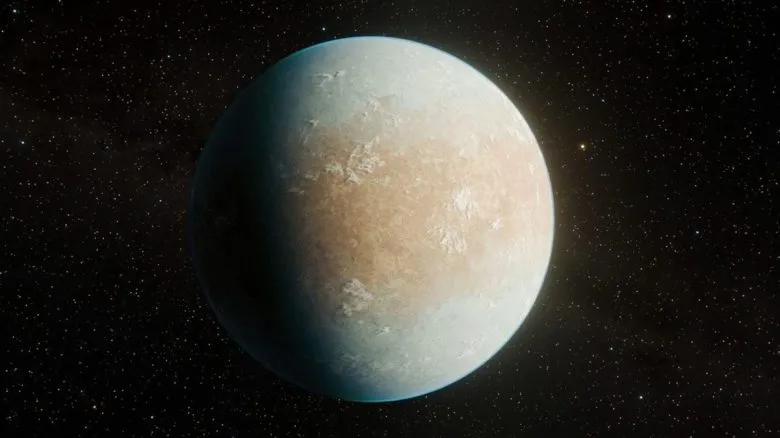
Astronomers have discovered a unique exoplanet, HD 137010 b, which is similar in size and orbit to Earth, but is characterized by an extremely harsh climate. HD 137010 b orbits a sun-like star located about 146 light-years away from Earth.
This is reported by Finway
Parameters and Climate Features of HD 137010 b
The exoplanet is likely to have a rocky structure, and its diameter is only slightly larger than that of Earth. A notable feature is its orbital period, which is nearly equal to one Earth year, a rarity among currently known planets outside the Solar System. This characteristic makes HD 137010 b valuable for study — most previously discovered exoplanets have significantly shorter orbital periods.
HD 137010 b is situated near the outer edge of the zone where liquid water could theoretically exist. However, researchers estimate that this planet receives less than a third of the energy that Earth receives from the Sun, due to its star being cooler and dimmer. Climate models suggest that the average surface temperature could be around –68 °C, making this planet even colder than Mars. Under such conditions, the existence of liquid water is virtually impossible, even despite its formal location in the habitable zone.
“The signal of its existence was detected during the K2 mission of the Kepler space telescope based on just one transit — the moment when the planet passes in front of the star’s disk. This is sufficient for preliminary estimates, but too little for definitive conclusions.”
Probability of Life and Future Research
The status of HD 137010 b has not yet been definitively confirmed. The discovery of the planet was made possible by the K2 mission of the Kepler telescope, which recorded only one transit. Due to its annual orbital period, such transits occur very rarely, so astronomers may need years to confirm the discovery. Further observations are planned using the TESS and CHEOPS telescopes, as well as the latest astronomical instruments.
According to scientists, despite the unfavorable prognosis, alternative scenarios cannot be ruled out. In particular, a dense atmosphere dominated by carbon dioxide could help retain heat. Depending on various models, the probability of HD 137010 b being in the habitable zone is estimated to be between 40% and 51%. At the same time, there is almost the same probability that the planet will turn out to be completely uninhabitable.
The discovery of HD 137010 b once again emphasizes that even planets with Earth-like parameters can have extreme and unfavorable conditions. Further research will help determine whether this exoplanet can be the key to understanding the habitability of other worlds or whether it will remain another testament to the complexity of the search for life in the Universe.