

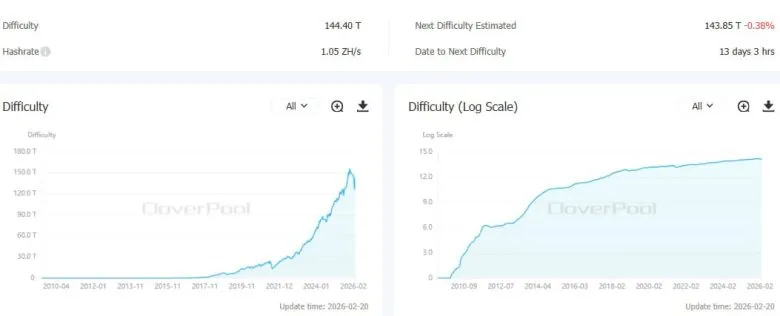
On February 19, 2026, the difficulty of mining Bitcoin showed a sharp increase of 14.73%, reaching a new record level of 144.40 T. According to analysts at CloverPool, this is the largest absolute jump in difficulty in recent times, occurring amid the recovery of hashrate following significant weather-related restrictions in the United States.
This is reported by Finway
Network Hashrate and Reasons for the Increase in Difficulty
The average hashrate of the Bitcoin network currently stands at 961.53 EH/s. This sharp increase is linked to the return to operation of a large portion of equipment after forced shutdowns during the recent winter storm in the U.S. At that time, operators of mining farms were compelled to temporarily halt operations to reduce the load on the power grid.
“The nearly 15% increase represents the largest absolute jump amid the recovery of hashrate following the extensive restrictions imposed during the recent winter storm in the U.S., noted The Block.”
Experts estimate that during the storm, over 200 EH/s of computational power were temporarily taken offline, leading to a decline in hashrate across major mining pools. For instance, Foundry USA, the largest pool by market share, experienced a hashrate drop of approximately 60%. During this period, the average block time increased to over 12 minutes, resulting in a temporary decrease in difficulty.
Difficulty Adjustment Mechanism and Market Outlook
The difficulty of mining Bitcoin is a relative measure that indicates how much harder it is to find new blocks compared to the easiest period in the network’s history. This parameter is automatically adjusted every 2016 blocks, which roughly corresponds to a two-week cycle.
Marty Bent, managing partner at Ten31, noted that the current recovery of capacities is related specifically to the return of farms to operation after weather restrictions, rather than a mass exit of miners due to risks associated with quantum computers or expansion into artificial intelligence.
It was previously reported that a solo miner managed to mine a Bitcoin block with a probability of less than 0.5%, earning a reward of approximately $215,000.
