

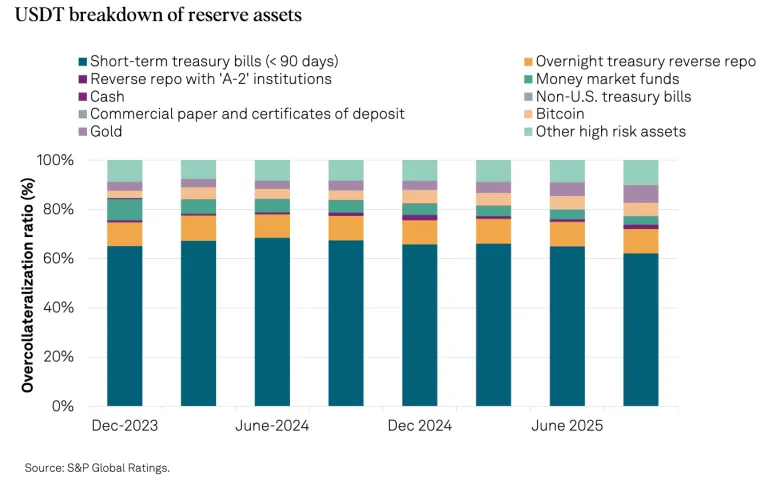
S&P Global Ratings has announced its decision to downgrade the stability rating of the USDT stablecoin to the lowest level on its scale. The agency’s experts expressed doubts about the token’s ability to maintain a stable peg to the US dollar, highlighting risks associated with the composition of its reserves.
This is reported by Finway
Composition of USDT Reserves and S&P’s Remarks
The agency’s report notes that the backing for USDT includes assets with heightened volatility, such as Bitcoin, gold, corporate bonds, and loans. According to S&P’s calculations, Bitcoin accounts for 5.6% of the total USDT reserves, while the collateralization ratio stands at 103.9%. Analysts emphasized that a decline in the value of cryptocurrencies or other risky assets could lead to a decrease in the collateral level of the stablecoin.
Furthermore, experts pointed out the limited scope of audits of the reserves and the regulatory peculiarities of Tether’s operations in El Salvador, where there are softer requirements for reserve assets. However, approximately 75% of USDT’s backing, according to S&P, consists of US Treasury bonds and other low-risk short-term instruments.

Tether’s Response to the Rating Agency’s Findings
“The propaganda machine is increasingly alarmed when any company attempts to challenge the gravitational pull of a broken financial system. No company should dare to separate itself from it,” stated the head of Tether.
Tether criticized the S&P report as “misleading.” Representatives of the issuer claimed that the data in the report distorts the true stability of USDT and does not reflect reality. Tether’s CEO Paolo Ardoino added that traditional rating models used by agencies have often supported companies that ultimately failed, even with high ratings.
At the same time, the company emphasized the scale of its reserves. Tether is one of the largest holders of US Treasury bonds — over $112 billion in short-term securities, which ensures the token’s reliability. The growth of gold reserves was also noted — the company has accumulated 116 tons of the metal, comparable to the reserves of Hungary and South Korea.
The S&P report was released against the backdrop of the active development of the stablecoin market following the passage of the Genius Act in the US and the increase in the market capitalization of the sector to over $300 billion. Tether’s significant reserves and operational flexibility have sparked discussions about its role, akin to that of a central bank in the crypto industry.
Additionally, analysts mentioned Tether’s recent entry into the Bitcoin-collateralized lending market, which occurred through investments in the Ledn platform.