

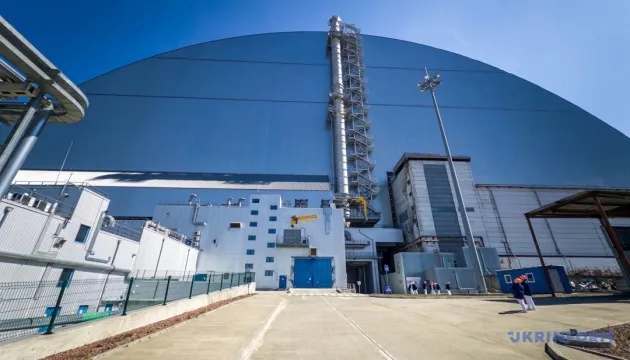
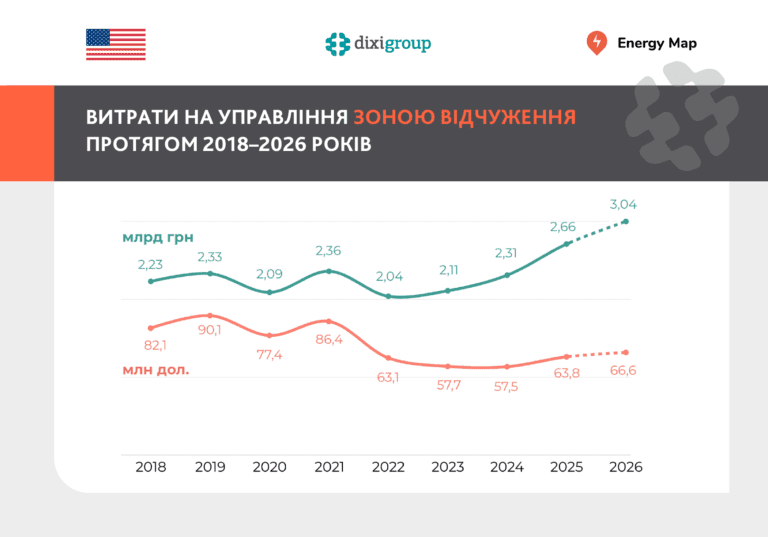
In 2025, Ukraine allocated 2.66 billion hryvnias for the maintenance of the Chernobyl exclusion zone, which is 15% more than in 2024. This data is based on analytics from DiXi Group and Energy Map.
This is reported by Finway
Main Funding Directions for the Chernobyl Zone
Overall, the state budget for 2025 provided for 2.8 billion UAH for the maintenance of the exclusion zone, of which the State Agency for Management of the Exclusion Zone (DASV) used 95% of the planned amount. The majority of the funds, specifically 1.4 billion UAH or 60.6%, was directed towards maintaining the safe condition of the stopped reactors at the Chernobyl Nuclear Power Plant and the “Shelter” facility (the sarcophagus).
Specifically, 1.52 billion UAH (57.1%) was spent on ensuring the safe condition of the reactors, the “Shelter” facility, and decommissioning measures. Another 0.53 billion UAH (20.1%) was allocated for decontamination, transportation, processing, and disposal of radioactive waste, as well as the development of the “Vector” complex.
Environmental Safety and Future Plans
For the support of environmental safety in the exclusion zone, 0.52 billion UAH (19.7%) was allocated. Other expenditures (3.1%) related to the preservation of the ethnocultural heritage of affected regions, management and administration of activities in the zone, as well as issues of radiological protection of the population.
“In 2025, Ukraine allocated 2.66 billion UAH for the management of the exclusion zone, including support for the safe condition of the stopped reactors at the Chernobyl Nuclear Power Plant, the “Shelter” facility (sarcophagus), handling of radioactive waste, environmental measures, and other related expenses. This is 15% more compared to 2024.”
For 2026, the state budget already provides for over 3 billion UAH for the management of the Chernobyl zone. It is specifically noted that the active phase of reconstruction of the Chernobyl Nuclear Power Plant confinement is expected to begin by 2028, with the completion of full restoration anticipated by 2030.
According to estimates from the European Bank for Reconstruction and Development, restoring the full functionality of the new safe confinement after the Russian attack could cost at least 500 million euros. Additional funding for these works will be needed as early as 2026-2027.