

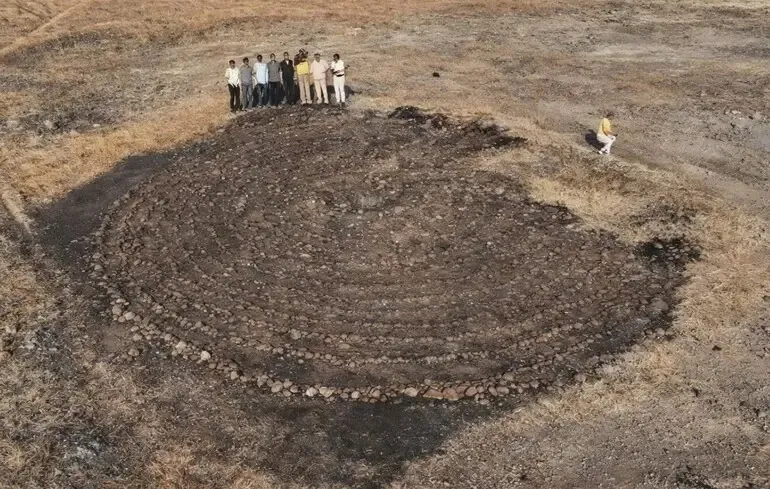
In the state of Maharashtra, in the Boramani meadows of Solapur district, archaeologists have stumbled upon a unique stone structure — a circular labyrinth consisting of fifteen concentric rings. This discovery marks a new phase in the study of ancient trade routes that connected India and the Roman Empire over two thousand years ago.
This is reported by Finway
Archaeological Sensation and Historical Context
The site was recorded by Sachin Patil, an archaeologist from Deccan College in Pune. Researchers believe that the labyrinth is linked to a period of intense trade between the city of Ter and Mediterranean countries in the early centuries AD. The discovery has generated significant resonance in the international scientific community, with a detailed analysis expected in the specialized British journal Caerdroia in 2026.
Until now, the largest circular labyrinth in India was considered to be a stone structure with eleven rings; however, the structure from Solapur significantly surpasses it in complexity and the number of contours. Its dimensions are approximately 15 by 15 meters, and the fifteen circular rings make it an absolute record-holder among similar structures in the country. In terms of area, the labyrinth is second only to the one in Gedimedu (Tamil Nadu), but it remains the largest specifically among circular stone labyrinths.
Significance of the Labyrinth and Cultural Connections
This structure is distinguished by the combination of a classic labyrinth design with a spiral at its center — an element characteristic of Indian tradition known as “chakravyuh.” Researchers suggest that similar structures served as landmarks for foreign traders, particularly from Rome, who brought gold, wine, and jewels in exchange for spices, silk, and indigo dye.
The region encompassing Kolhapur, Karad, and Ter was historically an important center for international trade. The architecture of the labyrinth bears similarities to patterns found on coins from Crete dating back to the 1st-3rd centuries AD, confirming its considerable age. Smaller labyrinths with eleven rings have also been discovered in the areas of Sangli, Satara, and Kolhapur, all located along the trade routes of the Satavahana dynasty.
Among the significant archaeological finds in the region are a statue of the Greco-Roman Poseidon and a bronze mirror from Brahmapuri, indicating close cultural contacts with the ancient world. The accumulation of this data points to the existence of an active trade corridor utilized by Greco-Roman merchants.
“The territory encompassing modern-day Kolhapur, Karad, and Ter was an important hub of international trade in ancient times. The design of the labyrinth resembles images on coins from the island of Crete that were in circulation in the 1st-3rd centuries AD, further confirming its considerable age — over two thousand years.”
The study of the labyrinth began accidentally — the site was noticed by representatives of a conservation organization during wildlife observations. After examination, archaeologists confirmed the authenticity of the structure: the layer of soil between the stone rings had remained untouched for many centuries.
Such labyrinths held not only practical but also symbolic significance. In various cultures, they were associated with concepts of fertility and spiritual focus. In local tradition, these labyrinths are referred to as “kode,” and they are also known by the names “chakravyuh,” “manchakra,” and “yamadwar.”